Adapted from an article by Matt Crouch, Auburn University (auburn.edu), March 6, 2023
Extra virgin olive oil may have positive effects on individuals with mild cognitive impairment, according to a recently completed study published in the journal Nutrients. The study’s findings suggest that compounds found in olive oil positively affect brain health and help improve the blood-brain barrier.
In the study, 25 adult participants experiencing mild cognitive impairment consumed 30 ml (about three tablespoons) of olive oil per day for six months. Thirteen of the participants consumed extra virgin olive oil (EVOO) and 12 consumed refined olive oil (ROO), as a control group. EVOO is rich in phenols, while ROO has been purified of phenols.
Study participants took several tests before and after consuming olive oil, including MRI scans, cognitive tests, and blood analysis to measure biomarkers related to Alzheimer’s disease.
This study evaluated the blood-brain barrier and its permeability—the degree to which it protects the brain. The blood-brain barrier, a network of blood vessels and tissue made up of closely spaced cells, plays a vital role in maintaining a healthy brain by protecting the brain from exposure to blood-related neurotoxins and in the clearance of brain waste products.
The study also measured levels of beta-amyloid and tau, two proteins associated with Alzheimer’s disease. In people with Alzheimer’s disease, levels of beta-amyloid and tau are increased.
The benefits of olive oil consumption were more pronounced in the EVOO group, but participants in the ROO group experienced improvements as well: Both EVOO and ROO improved cognitive function, as determined by the improved clinical dementia rating and other behavioral scores. Additionally, “our findings showed that EVOO and ROO altered two major biomarkers related to Alzheimer’s disease,” said Kaddoumi. “These alterations collectively could have played a role in improving the blood-brain barrier and improving function and memory.”
This study in individuals with mild cognitive impairment is the first to evaluate what happens to the human brain as a result of consuming olive oil.
“These results are exciting because they support the health benefits of olive oil against Alzheimer’s disease,” said Kaddoumi. “Based on the findings of this study and previous preclinical studies… we can conclude that adding olive oil to our diet could maintain a healthy brain and improve memory function.”
Reference: Kaddoumi A, Denney TS, Deshpande G et al. Extra-virgin olive oil enhances the blood-brain barrier function in mild cognitive impairment: a randomized controlled trial. Nutrients. 2023;14(23):5102. doi.org/10.3390/nu14235102.
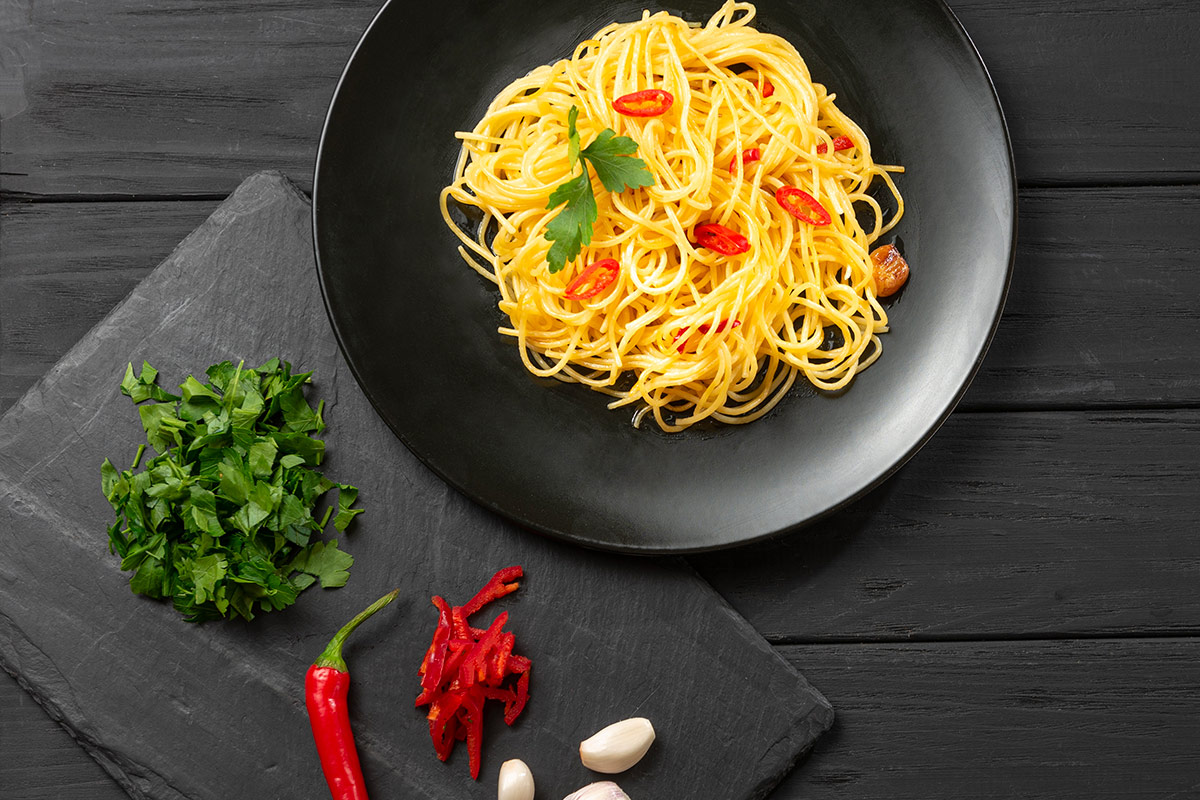
Pasta with Garlic and Olive Oil Recipe, Protecting Brain Health Through Diet: More Benefits of the Olive Oil Lifestyle
More and more research is linking certain diets to better brain health and the possibility of warding off various types of dementia, including Alzheimer’s disease. It’s encouraging to read about variations on the Mediterranean diet, all of which deliver the benefits of olive oil. The study I’m sharing owes a huge debt to its participants who were willing to not only keep food diaries, but also allow scientists to examine their brains after they passed, thereby enlightening the rest of us. One clear message I like to communicate is that “good for you” foods also taste great—there doesn’t need to be a trade-off, as the following pasta recipe proves.
This recipe hails from one of my favorite regions in one of my favorite countries—Lazio, Italy. Fresh-Pressed Olive Oil Club members recently got to savor a bold Canino olive oil from a wonderful producer, an agricultural cooperative of small local farmers who carry on their respective family traditions and passion for growing olives. I’m happy to say that this classic pasta dish is divine with any of the Club’s extra virgin olive oils! You probably have the ingredients in your kitchen already, so you can be enjoying it tonight. For an even healthier meal, choose whole wheat pasta or an alternative made with legumes, such as black beans or yellow pea protein.
Ingredients
1 tablespoon coarse salt
1 pound pasta, any variety, fresh or dried
1/3 cup extra virgin olive oil, plus more for drizzling
4 cloves garlic, minced
1 fresh pepperoncini or red chile pepper, thinly sliced, or crushed red pepper flakes to taste
1/4 cup chopped flat-leaf parsley
Directions
Step 1
Bring a large pot of cold water to a boil over high heat and add the salt. Add the pasta and cook until al dente, about 7 or 8 minutes.
Step 2
While the pasta is cooking, heat a large skillet and, when very warm, add the olive oil, garlic, and pepper (if using crushed flakes, add them later, as noted below). Cook over medium heat until the garlic softens and starts to turn color, about 5 minutes.
Step 3
Use tongs to transfer the pasta to the skillet along with a 1/4 cup of its cooking water. Toss well to coat the pasta in the oil and continue cooking for another 2 minutes until the pasta water is just about fully absorbed (if using pepper flakes, add them now). Sprinkle with the parsley, drizzle with more olive oil, and serve.
Yields 4 servings
Protecting Brain Health Through Diet
More Benefits of the Olive Oil Lifestyle
The Study: “Association of Mediterranean-DASH Intervention for Neurodegenerative Delay and Mediterranean Diets With Alzheimer Disease Pathology,” Neurology, March 8, 2023.
The Findings: People who eat diets rich in green leafy vegetables as well as other vegetables, fruits, whole grains, olive oil, beans, nuts, and fish may have fewer amyloid plaques and tau tangles in their brain—signs of Alzheimer’s disease—than people who do not consume such diets.
The Report: According to an American Academy of Neurology report on the study, researchers looked at how closely people followed the Mediterranean diet and a variation called the MIND (Mediterranean-DASH Intervention for Neurodegenerative Delay) diet. Although similar, the Mediterranean diet recommends vegetables, fruit, and three or more servings of fish per week, while the MIND diet prioritizes green leafy vegetables like spinach, kale, and collard greens, along with other vegetables and berries over other fruit, and recommends one or more servings of fish per week. Both the MIND and Mediterranean diets recommend small amounts of wine.
“These results are exciting—improvement in people’s diets in just one area, such as eating more than six servings of green leafy vegetables per week, or not eating fried foods, was associated with fewer amyloid plaques in the brain similar to being about four years younger,” says study author Puja Agarwal, PhD, of RUSH University in Chicago.
The study shows an association between regularly consuming these diets and fewer Alzheimer’s disease plaques and tangles, although it doesn’t establish a cause-and-effect relationship. “While our research doesn’t prove that a healthy diet resulted in fewer brain deposits of amyloid plaques, also known as an indicator of Alzheimer’s disease, we know there is a relationship, and following the MIND and Mediterranean diets may be one way that people can improve their brain health and protect cognition as they age,” explains Dr. Agarwal.
The study involved 581 people with an average age of 84 at the time of their diet assessment who agreed to donate their brains at death to advance dementia research. Participants completed annual questionnaires asking how much they ate of food items in various categories. The participants died an average of seven years after the start of the study. Right before death, 39 percent had been diagnosed with dementia. When examined after death, 66 percent met the criteria for Alzheimer’s disease.
At autopsy, researchers examined participants’ brains to determine the amounts of amyloid plaques and tau tangles (both are found in the brains of people with Alzheimer’s disease but may also be found in the brains of older people with normal cognition). They then looked back at the food questionnaires and ranked the quality of diet for each person.
For the Mediterranean diet, there were 11 food categories. Participants were given a score of zero to 55, with higher scores if they adhered to the diet in these categories: whole grain cereals, fruits, vegetables, legumes, olive oil, fish, and potatoes. They were given lower scores if they ate red meat, poultry, and full-fat dairy products.
For the MIND diet, there were 15 categories. Participants were scored one point each for eating from 10 brain-healthy food groups: green leafy vegetables, other vegetables, nuts, berries, beans, whole grains, fish, poultry, olive oil, and wine. They lost a point if they ate greater than recommended amounts of foods in five unhealthy groups: red meats, butter and margarine, cheese, pastries and sweets, and fried and fast food.
Researchers then divided participants into three groups for each diet and compared those in the highest groups to those in the lowest groups. For the Mediterranean diet, people in the highest group had an average score of 35, while those in the lowest group had an average score of 26. For the MIND diet, the highest group had an average score of nine while the lowest group had an average score of six.
After adjusting for age at death, sex, education, total calorie intake, and whether people had a gene linked to a greater risk of Alzheimer’s disease, researchers found people who scored highest for adhering to the Mediterranean diet had average plaque and tangle amounts in their brains similar to being 18 years younger than people who scored lowest. Researchers also found people who scored highest for adhering to the MIND diet had average plaque and tangle amounts similar to being 12 years younger than those who scored lowest.
When looking at single diet components, the researchers found that people who ate the highest amounts of green leafy vegetables—seven or more servings per week—had plaque amounts in their brains corresponding to being almost 19 years younger than people who ate the fewest (one or fewer servings per week). “Our finding that eating more green leafy vegetables is in itself associated with fewer signs of Alzheimer’s disease in the brain is intriguing enough for people to consider adding more of these vegetables to their diet,” says Agarwal. “Future studies are needed to establish our findings further.”
Note: A limitation of the study was that participants were mostly white, non-Hispanic, and older, so the results cannot be generalized to other populations.
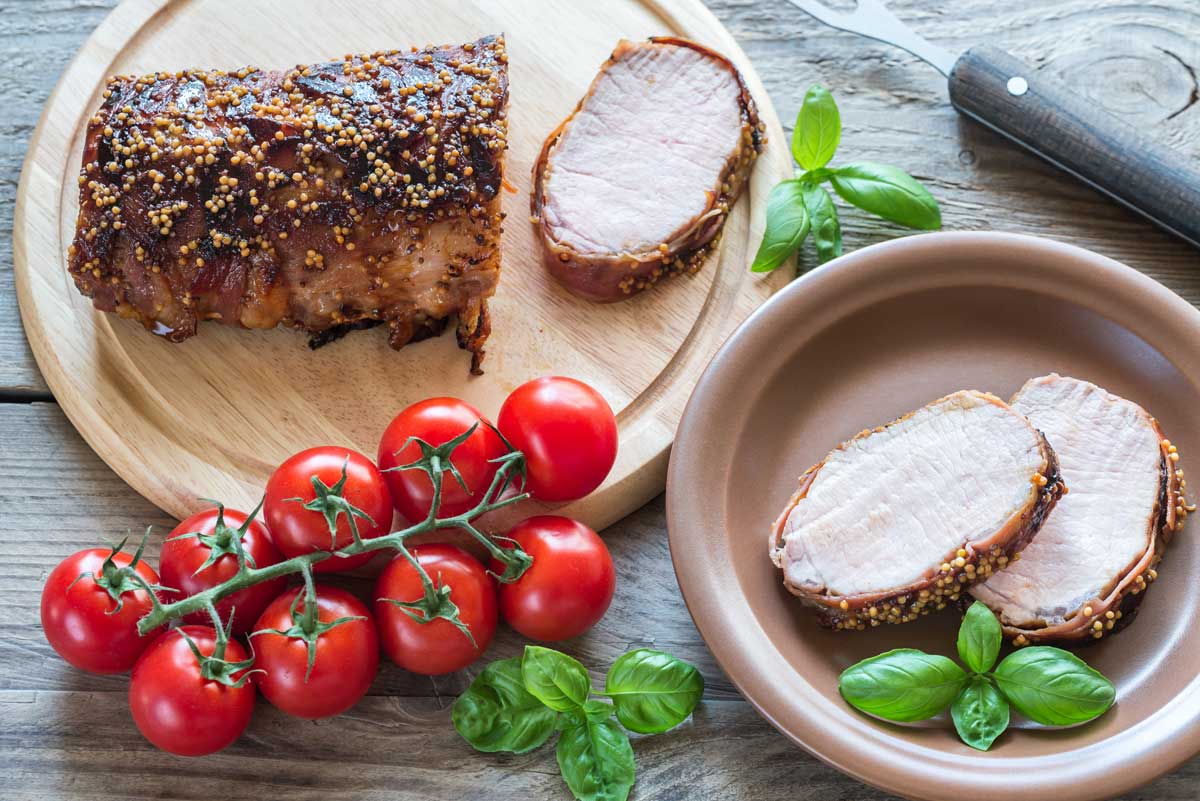
Pork Tenderloin with Tomato and Onion Salad Recipe, Spotlight on Pork Tenderloin, Meat Safety, Rethinking Moderate Drinking and Trading the Chair for Fresh Air
Labor Day is the perfect occasion to think about how much time you spend sitting while you’re at work and how this can affect your health—new research shows that we should all be moving more! As you gather with family and friends, talk about ways you can encourage each other to be healthier. This week’s celebratory recipe features pork tenderloin, a very lean cut, and two of the healthiest veggies—a great break from traditional burgers and dogs.
If you’re firing up the grill this weekend, this simple but colorful dish makes an impressive centerpiece. For a crowd, simply double or triple the recipe. In addition to the tomato and onion salad, make a tasty side dish by first grilling up seasonal vegetables—brush them with olive oil and cook for two minutes per side or until tender. Note: You can enjoy this pork dish any time of year by cooking it in a large cast-iron skillet on your stovetop.
Ingredients
2 cups red and yellow cherry tomatoes, halved
1 small red onion, peeled and thinly slivered lengthwise
1 to 2 cloves garlic, finely minced
1 to 2 tablespoons red wine vinegar or sherry vinegar, or to taste
1 tablespoon chopped fresh parsley or cilantro
1/4 teaspoon ground cumin
1/4 teaspoon dried oregano
1/4 teaspoon dried thyme
1/4 teaspoon hot red pepper flakes
Coarse salt
Freshly ground black pepper
1/3 cup extra virgin olive oil, plus more for coating the pork
2 pork tenderloins, about 1 pound each
Directions
Step 1
Place the tomatoes and onions in a medium-sized bowl. In a jar with a tight-fitting lid, combine the garlic, vinegar, parsley, cumin, oregano, thyme, red pepper flakes, and salt and pepper to taste. Add the olive oil and shake vigorously until emulsified. Pour over the tomato-onion mixture and toss to combine. Set aside to marinate while grilling the pork.
Step 2
Preheat an outdoor grill to medium-high heat. Lightly coat the pork with olive oil and season it generously with salt and pepper. Grill the pork until nicely browned on the outside, turning as needed, and cooked to an internal temperature of 145°F—it will be slightly pink in the center. Let rest for three minutes, then slice crosswise on a diagonal into 1/2-inch-thick pieces. Shingle on a platter.
Step 3
Stir the tomato-onion salad once more, taste for seasoning, and then spoon it around the pork.
Yields 4 servings
Healthy Ingredient Spotlight
Perfectly Petite Pork
Pork tenderloin is a choice, lean, and elegant cut, with a shape similar to that of a filet mignon, but with a smaller circumference and length. With so little fat, it’s best quickly cooked over fairly high heat, which is why a hot grill is a great option. Since a tenderloin weighs only about a pound, estimate one for every two or three people.
To prep it, use a boning knife to remove any strips of silver skin. Olive oil enhances pork’s delicate taste. To infuse it with even more flavor, marinate it in the oil, some wine vinegar, and the herbs used in the tomato salad—or any favorites you have on hand—for an hour before cooking.
Healthy Kitchen Nugget
Meat Safety: Temperature is Everything
The directions concerning the internal temperature and resting time for the pork tenderloin come from important changes the USDA made in May 2020. It lowered the recommended safe cooking temperature for whole cuts of pork from 160ºF to 145ºF as measured with a food thermometer, and added in the three-minute rest time before carving or eating it. This translates to pork that is both safe and juicy.
Rest time is technically the amount of time a food remains at its final temperature after it has been removed from a grill, oven, or other heat source. During those three minutes, the food’s temperature remains constant or continues to rise, which destroys harmful bacteria. Adding this rest time enabled USDA internal temperature guidelines to be lowered from 160ºF, which tended to dry out the meat. To check for doneness, always place your food thermometer in the thickest part of a food. Start checking toward the end of the anticipated cooking, but before you expect it to be done. Always wash your food thermometer with hot soapy water before and after each use.
For Your Best Health
Rethinking Moderate Drinking
Long-standing consumption caps on alcoholic beverages have suggested one or less per day for women and two or less per day for men. But a new study of nearly 21,000 people published in the journalPLOS suggests that drinking at the high end of that safe range is linked to brain changes and cognitive decline from iron accumulation in the brain, which has itself been linked with Alzheimer’s and Parkinson’s diseases and is a potential mechanism for alcohol-related cognitive decline.
Dr. Anya Topiwala of the University of Oxford, United Kingdom, along with colleagues, explored relationships between alcohol consumption and brain iron levels. Study participants, whose mean age was 55 and who represented both sexes nearly equally, reported their own alcohol consumption, and their brains were scanned using magnetic resonance imaging (MRI). Almost 7,000 participants also had their livers imaged using MRI technology to assess levels of systemic iron. All completed a series of simple tests to assess their cognitive and motor functions.
Although 2.7 percent of participants classified themselves as nondrinkers, average intake was around 18 units per week, which translates to about seven and a half cans of beer or six large glasses of wine. The research team found that alcohol consumption above seven units per week was associated with markers of higher iron in the basal ganglia, a group of brain regions associated with control of motor movements, procedural learning, eye movement, cognition, emotion, and more. Iron accumulation in some brain regions was associated with worse cognitive function.
Although drinking was self-reported and could be underestimated, this was considered the only feasible method to establish such a large cohort’s intake. Another limitation of the work is that MRI-derived measures are indirect representations of brain iron, and could conflate other brain changes observed with alcohol consumption with changes in iron levels. However, the findings certainly justify taking a careful look at how much you’re drinking on a weekly basis and considering whether cutting back should be part of your brain health strategy.
Fitness Flash
Trade the Chair for Fresh Air
New research done at Simon Fraser University in Canada and published in the journal JAMA Cardiology adds to what we know about the dangers of too much sitting. The international study surveyed more than 100,000 people in 21 countries over an average of 11 years and found that those who sat for six to eight hours a day had a 12–13 percent increased risk for early death and heart disease; for people who sat for more than eight hours daily, the increased risk went up to 20 percent. Those who sat the most and were the least active had the highest risk—up to 50 percent—while those who sat the most but were also the most active had a risk of about 17 percent.
“The overarching message here is to minimize how much you sit,” says study co-leader Scott Lear, PhD, professor and Pfizer/Heart & Stroke Foundation chair in cardiovascular prevention research at Simon Fraser.“If you must sit, getting in more exercise during other times of the day will offset that risk.” Less sitting and more activity is a low-cost intervention that can have enormous benefits, he explains, adding that we all need to better assess our lifestyle and take health seriously. “Our study found that a combination of sitting and inactivity accounted for 8.8 percent of all deaths, which is close to the contribution of smoking. It’s a global problem that has a remarkably simple fix. Scheduling time to get out of that chair is a great start.”
Nutty Oat Muffin Recipe, Spotlight on Oats (and Groats), plus the Body, Gut, and Brain Connection
This week’s news shows just how connected the body, gut, and brain are, with what we eat and how we move very much linked to our mental health. My nutty oat muffin recipe, so easy to make in less than 30 minutes, not only tastes great but can also help boost brain health as well as gut health, thanks to those oats. And we’re learning that movement goes beyond boosting physical health to also benefiting the brain—you can even pick types of exercise based on what mental benefits you seek.
These muffins have a great crunch and are packed with whole grain goodness.
Ingredients
1-1/2 cups white whole wheat or whole wheat pastry flour
3/4 cup rolled oats
2 ounces almonds or walnuts, roughly chopped
1 tablespoon baking powder
1/4 cup brown sugar
1 tablespoon stevia
1/2 teaspoon ground cinnamon
1/2 teaspoon fine sea salt
1 cup blueberries, rinsed and patted dry
4 tablespoons extra virgin olive oil
2 extra-large eggs
1 cup milk, your choice of dairy or plant-based
2 teaspoons vanilla extract or paste
Directions
Step 1
Preheat your oven to 400ºF if conventional, 380ºF if convection. In a large bowl, whisk together the flour, oats, nuts, baking powder, sugar, stevia, cinnamon, and salt. Add the berries and toss to coat (this will help them stay well distributed in the batter).
Step 2
In a separate bowl or measuring cup, whisk together the olive oil, eggs, milk, and vanilla. Pour the liquid ingredients over the flour mixture and use a spatula to fold them in just until no traces of flour remain.
Step 3
Use a large ice cream scoop to fill a 12-muffin tin and bake for 20 minutes or until the tip of a knife comes out clean. Cool for 10 minutes and then transfer the muffins to a rack to finish cooling. Store in a covered tin for up to two days and then refrigerate.
Yields 12 muffins
Healthy Ingredient Spotlight
From groats to oats
Oats are known as a good source of soluble fiber—the 5 grams per serving help lower cholesterol levels and heart disease risk. Oatmeal is just the beginning of what you can make from rolled oats. In the recipe above, they meld beautifully into the finished muffins. But when a hot bowl of oatmeal is on the breakfast menu, you might be wondering whether you should start with popular steel-cut oats instead. Both come from oat groats, the oat grain with the hull removed (the bran and germ are intact, so oats are still considered a whole grain). What happens to the groats next explains the difference between rolled and steel-cut oats.
Rolled oats are oat groats that have been steamed and then passed through roller mills. The thicker the rolled oats, the more nutrients they pack.
Steel-cut oats are groats that have only been chopped into two or three pieces, no steaming or rolling. They need to be cooked much longer than rolled oats and are better in breakfast bowls than baked goods—they simply won’t soften enough. Because they need more water to cook than rolled oats, you end up with a bigger portion by volume. Finally, they’re digested more slowly than rolled oats; you feel full longer and have less of a spike in blood sugar—important if you’re managing a health condition like diabetes or prediabetes.
Healthy Kitchen Nugget
A better vanilla?
If you’re looking for intense vanilla flavor but don’t want to go to the expense of buying vanilla beans, consider using vanilla paste in place of extract. You can use it teaspoon-for-teaspoon in recipes for a deeper flavor, plus it has vanilla bean seeds for that characteristic speckled look, and because it’s thicker, it adds less liquid to batters. Though you often see the suggestion to use vanilla bean paste in desserts where the vanilla is the star, such as ice cream, custard, and crème brûlée, I find it perks up the flavor of any recipe that calls for extract.
For Your Best Health
Fiber: The new brain food
You already know that fiber is a must for digestive health and that we often don’t get enough. Need more motivation to up your intake? Researchers in Japan found that fiber may help brain health. Their study, just published in the journal Nutritional Neuroscience, looked at the diet and health records of 3,500 participants from the 1980s to 2020. They found a link between a high-fiber diet and a reduced risk of dementia.
There are two main types of fiber. Insoluble fibers, found mostly in whole grains and vegetables, are important for bowel health. Soluble fibers, found in foods like oats and legumes, are important for the beneficial bacteria that live in the gut, among other health benefits. When the researchers looked at the link between fiber intake and dementia, they found that soluble fiber had a more pronounced effect.
“The mechanisms are currently unknown but might involve the interactions that take place between the gut and the brain,” says lead author of the study, Kazumasa Yamagishi, MD, professor at the University of Tsukuba. “One possibility is that soluble fiber regulates the composition of gut bacteria. This composition may affect neuroinflammation, which plays a role in the onset of dementia. It’s also possible that dietary fiber may reduce other risk factors for dementia, such as body weight, blood pressure, lipids, and glucose levels. The work is still at an early stage, and it’s important to confirm the association in other populations.”
While we wait, there’s no reason not to stock up on those oats!
Fitness Flash
Movement for the brain
More amazing boosts to brain health come from exercise. A fascinating article posted by the Greater Good Science Center at the University of California, Berkeley, explores the new book Move!: The New Science of Body Over Mind (Hanover Square Press) by Caroline Williams, who points out that the connection between exercise and the brain goes deeper than the release of feel-good endorphins known as a runner’s high.
She describes how movement or the lack of it can send signals we may not even be aware of to the brain. As the article explains it: “If our body is communicating to our brain that we are sedentary or weak, that might create underlying feelings of depression or anxiety, insecurity or uncertainty. On the flip side, moving and building strength could create positive changes in our bodily systems that, when passed along to the brain, give us a subtle sense of happiness, confidence, and positivity.”
Based on interviews with researchers and practitioners around the world, Williams details the many ways that working your body can influence and improve your brain for the better. It’s full of suggestions for different ways of moving that have different brain health benefits. So, while any exercise is helpful for the body physically, you can also make choices tailored to your best mental health, like taking a group fitness class to feel more connected socially or dancing to your favorite music to escape anxiety while getting lost in its rhythms.