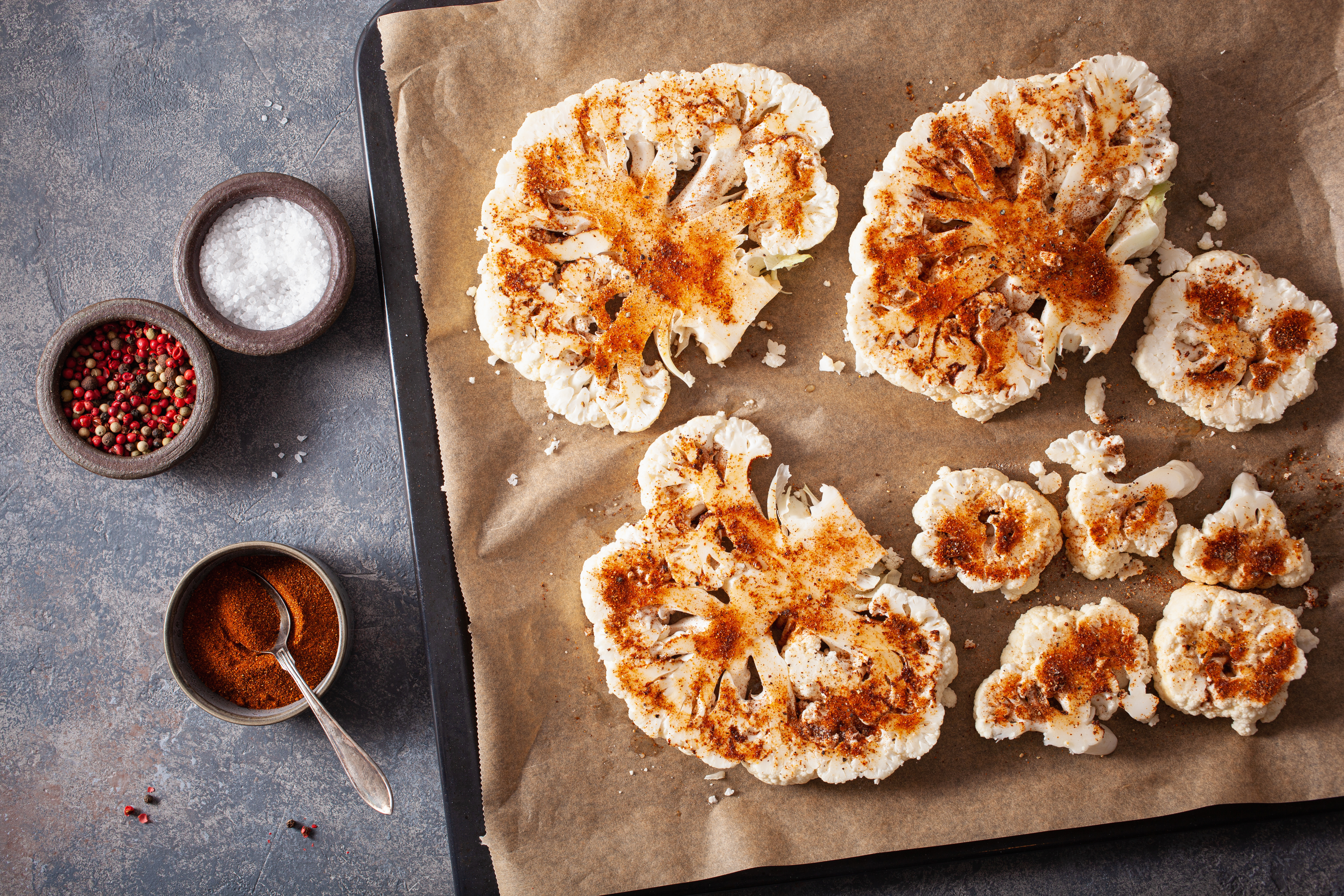
My twist on this now-classic dish is to serve it with dukkah, a little-known nut-and-spice blend that’s Egyptian in origin but has been wildly popularized half a world away in Australia. Dukkah is wonderful on vegetables, but you can use it to make compound butter or as a sandwich spread, to add zest to a basic pesto, or simply instead of salt and pepper—I like to think of it as five layers of flavor in one little sprinkle. At Aussie restaurants, you’ll often find it added to the dish of olive oil that is served with bread.
Ingredients
2 large heads of cauliflower
Extra virgin olive oil
Coarse kosher or sea salt
2 lemons, each cut into 4 wedges, separated
Fresh chopped curly parsley
For the dukkah:
1 cup hazelnuts, cashews or almonds
1/2 cup sesame seeds
1/4 cup coriander seeds
2 tablespoons cumin seeds
1 tablespoon freshly ground black pepper
1 teaspoon coarse salt
1/4 teaspoon cayenne
Directions
Step 1
To make the dukkah, start by toasting the nuts. Place them on a rimmed baking sheet and roast for about 10 minutes at 350°F until lightly browned. Set aside to cool (it’s not necessary to remove their skins), reserving the baking sheet for the cauliflower. Dry-toast the sesame, coriander and cumin seeds in a small frying pan on the stovetop, stirring constantly until fragrant, about 3 minutes. Keep your eye on them because they can burn easily. Transfer the nuts and seeds to a food processor and add the salt, pepper and cayenne. Pulse just until crumbly. Don’t overprocess, or the dukkah will turn into a paste. Alternatively you can use a mortar and pestle or spice grinder. (This can be made in advance. Refrigerate if not using immediately.)
Step 2
Next, turn the oven up to 400°F and prep the cauliflower. Remove the green outer leaves from each head and carefully trim back the stem. Stand the cauliflower upright on a cutting board and cut 2 “steaks,” each about ¾” thick, from the center of each head. Reserve the remaining cauliflower florets for another dish.
Step 3
Arrange the steaks on the rimmed baking sheet (you may need an additional sheet if the heads are very large). For each slice, brush both sides with olive oil and squeeze on the juice from one lemon wedge. Season with salt and pepper. Roast, turning once with a spatula, until the cauliflower is tender and both sides are nicely browned, about 30 minutes. Transfer to a platter and liberally dust each piece with the dukkah. Drizzle with more olive oil, sprinkle with parsley, and serve with the rest of the lemon wedges.
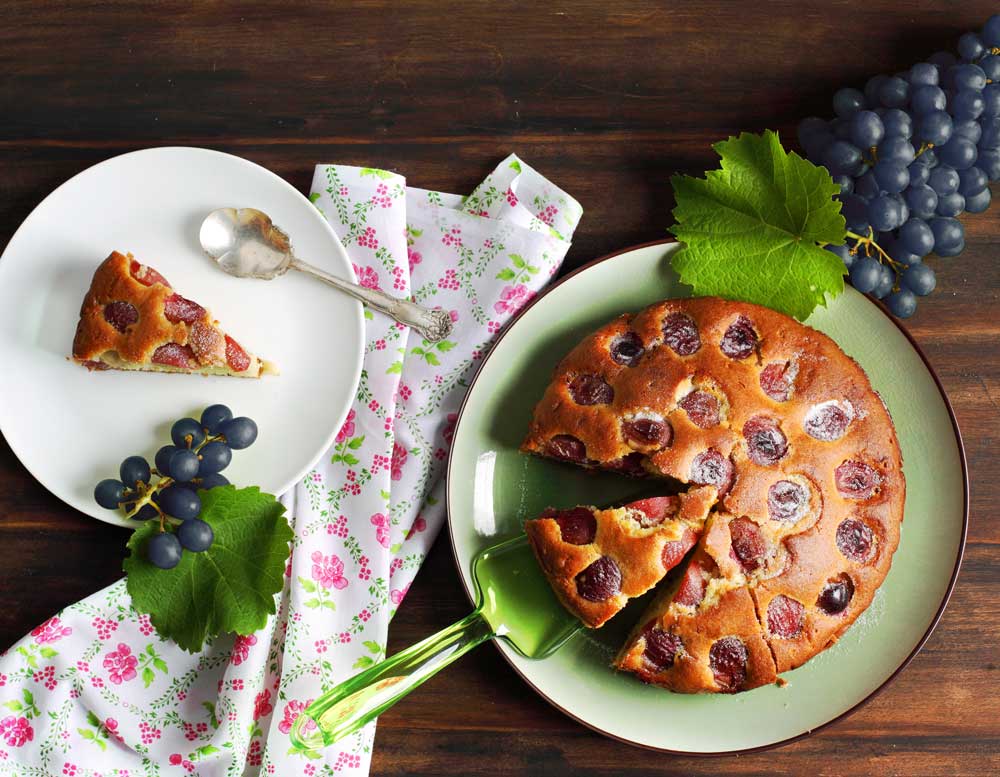
This cake includes one of my favorite nuts—pistachios—and, of course, extra virgin olive oil. You’ll love this cake with a scoop of ice cream for dessert or on its own for breakfast the next day…if you have any left!
Ingredients
3/4 cup cake flour
1-1/2 teaspoons baking powder
Pinch of salt
1 cup Concord grapes
1/2 cup unsalted, shelled pistachios
4 tablespoons confectioner’s sugar
2 large eggs
1 cup sugar, divided
1 teaspoon vanilla extract
1/2 cup extra virgin olive oil
4 large egg whites
1 tablespoon sanding sugar (optional)
Directions
Step 1
Preheat your oven to 350ºF. Line the bottom of a 9″ springform pan with parchment paper, and lightly coat it with baking spray. In a large bowl, whisk together the flour, baking powder, and salt. Over another large bowl to catch the juice, slice the grapes in half and remove and discard the seeds; set aside.
Step 2
In a food processor, pulse the pistachios with the confectioner’s sugar until powdery. Add the 2 whole eggs, 3/4 cup of the sugar, and the vanilla extract, and then pulse about 6 times to incorporate the ingredients. Add half of the flour mixture, then the olive oil, and then the remaining flour mixture, pulsing a few times between each addition. Transfer the batter to the bowl you used for the flour, and fold in any juice that’s collected in the bowl of grapes.
Step 3
In a clean, large bowl, whisk the egg whites on a low speed until foamy, add the remaining 1/4 cup of sugar, and whip at high speed until stiff peaks form. Fold a large spoonful of the beaten whites into the batter to lighten the mixture. Then gently fold in the remaining egg whites, being sure to incorporate the batter at the very bottom of the bowl. Transfer the batter to the prepared pan, smoothing the top, and then sprinkle on the grapes and, if you’re using it, the sanding sugar. Bake for 50 to 60 minutes, until there’s no wobble in the center and a knife used to test comes out clean. Cool on a rack for 10 minutes, and then release the sides of the pan. Serve at room temperature.
Concord Grape and Olive Oil Harvest Cake Recipe, Spotlight on Concord Grapes, The Power of Pistachios and Naps
When I was growing up, my grandparents had several Concord grapevines. I loved to pick the deep-purple clusters and wished I could have them all year-round. Since early fall is the only time they’re available, I’ve always been excited for this season. The Concord grape and olive oil harvest cake I’m sharing with you in this week’s newsletter also includes one of my favorite nuts—pistachios—and, of course, extra virgin olive oil. Members of the Fresh-Pressed Olive Oil Club can use any of their selections for this recipe, but a bold and fruity choice is wonderful with the fruit and nuts. You’ll love this cake with a scoop of ice cream for dessert or on its own for breakfast the next day…if you have any left!
This cake includes one of my favorite nuts—pistachios—and, of course, extra virgin olive oil. You’ll love this cake with a scoop of ice cream for dessert or on its own for breakfast the next day…if you have any left!
Ingredients
3/4 cup cake flour
1-1/2 teaspoons baking powder
Pinch of salt
1 cup Concord grapes
1/2 cup unsalted, shelled pistachios
4 tablespoons confectioner’s sugar
2 large eggs
1 cup sugar, divided
1 teaspoon vanilla extract
1/2 cup extra virgin olive oil
4 large egg whites
1 tablespoon sanding sugar (optional)
Directions
Step 1
Preheat your oven to 350ºF. Line the bottom of a 9″ springform pan with parchment paper, and lightly coat it with baking spray. In a large bowl, whisk together the flour, baking powder, and salt. Over another large bowl to catch the juice, slice the grapes in half and remove and discard the seeds; set aside.
Step 2
In a food processor, pulse the pistachios with the confectioner’s sugar until powdery. Add the 2 whole eggs, 3/4 cup of the sugar, and the vanilla extract, and then pulse about 6 times to incorporate the ingredients. Add half of the flour mixture, then the olive oil, and then the remaining flour mixture, pulsing a few times between each addition. Transfer the batter to the bowl you used for the flour, and fold in any juice that’s collected in the bowl of grapes.
Step 3
In a clean, large bowl, whisk the egg whites on a low speed until foamy, add the remaining 1/4 cup of sugar, and whip at high speed until stiff peaks form. Fold a large spoonful of the beaten whites into the batter to lighten the mixture. Then gently fold in the remaining egg whites, being sure to incorporate the batter at the very bottom of the bowl. Transfer the batter to the prepared pan, smoothing the top, and then sprinkle on the grapes and, if you’re using it, the sanding sugar. Bake for 50 to 60 minutes, until there’s no wobble in the center and a knife used to test comes out clean. Cool on a rack for 10 minutes, and then release the sides of the pan. Serve at room temperature.
Yields 10-12 servings
Healthy Ingredient Spotlight
Concord Grapes
Just as deeply colored berries have amazing and healthful antioxidants, so do deeply colored grapes. In fact, a study in the journal Antioxidants that compared Concord, purple, red, and green grapes found that the Concord and the purple grapes had the highest concentration of antioxidants. What’s more, of all the grapes, the Concords had the most not just in their skins, but in their pulp as well. This—and their wonderful intense flavor—makes having to deal with those little seeds worth the trouble.
Healthy Kitchen Nugget
Concord Grape Shopping Smarts
Look for bunches with dark blue-purple grapes and a dusty “bloom,” or light whitish finish—this is a natural protectant. It’s common to find a few grapes on any given bunch that haven’t ripened and are still green. Just discard them because they’ll be sour. Store Concord grapes, unwashed, in the crisper drawer of your fridge for up to two weeks; rinse before eating or prepping them. They also freeze well and make an icy treat if you eat them without thawing.
For Your Best Health
Pistachio Power
Whenever I read studies about how healthful nuts are, I typically think of walnuts and almonds, but according to a report in the journal Natural Product Research, pistachios pack an enviable nutrient punch, making them a great, guilt-free snack. “Compared to other nuts, pistachios have a lower fat and caloric content, and contain the highest levels of unsaturated fatty acids, potassium, γ-tocopherol [vitamin E], phytosterols, and xanthophyll carotenoids, all substances that are well known for their antioxidant and anti-inflammatory actions.” More details come from a review of pistachios in the journal Nutrients. “Pistachios are also a good source of vegetable protein, with an essential amino acid ratio higher than most other commonly consumed nuts…The amount of total carbohydrates is low to moderate, but they are richer in fiber than other nuts with a 10% by weight of insoluble forms and 0.3% of soluble forms…This complete and diverse set of micronutrients and macronutrients means that pistachio nuts are potentially one of the more health-promoting foods.” They also help you feel full, so you’re less likely to overeat.
When it comes to taste, I especially adore pistachios from Turkey, available from many online purveyors, as well as the Bazzini brand (bazzininuts.com). In Sicily, I fell in love with the pistachios from Bronte, the village on Mount Etna, where they’re called “green gold”—it’s possible to buy them online at gustiamo.com, but they are quite an indulgence at more than $40 per half-pound!
For convenience when cooking, buy raw, shelled kernels. With a few pulses in the food processor, you can turn them into pistachio flour for cakes or pistachio paste for cake or candy fillings. For the smoothest paste, blanch raw pistachios for two minutes in boiling water, drain them, and use a kitchen towel to rub off the skins. Whether or not you skin them, you can toast them for a few minutes in a low-temperature oven or a dry skillet to bring out their flavor. Pre-roasted pistachios typically have a bit of salt, so they’re trickier to use in sweet recipes (you may be able to simply omit any other salt listed in the ingredients). Nuts.com is a great source for both raw and roasted pistachios.
Fitness Flash
A New Look at Naps
A study in the journal Sleep has found that while taking a nap can be a bit helpful, it can’t replace missed sleep. Researchers from Michigan State University tested whether napping could compensate for the cognitive deficits—such as the ability to think clearly—linked with sleep deprivation. “We found that short naps of 30 or 60 minutes did not show any measurable effects,” said Kimberly Fenn, PhD, an associate professor and director of the Sleep and Learning Lab. But there was a positive. Napping does get you some “slow-wave sleep,” considered the most important sleep stage. This can reduce the number of mistakes you make when you’re sleep deprived. The research noted that every 10-minute increase in slow-wave sleep can reduce errors by about 4%, an amount that sounds small but could make a big difference, especially for people in professions that require life-and-death decision-making—think doctors and police officers.
Garden Pasta alla Hermes Recipe, Spotlight on Gluten-Free Pasta, Benefits of Green Foods and Canned Tomatoes, Plus Boosting Your Brain
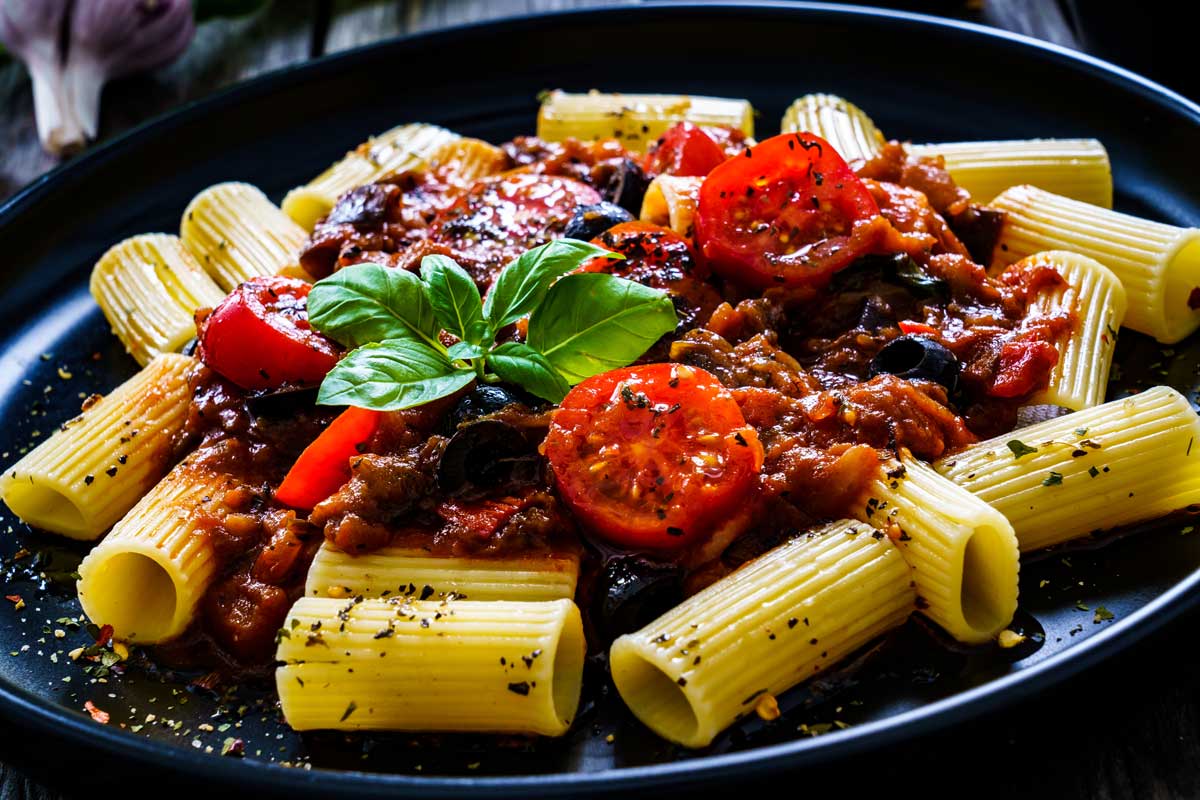
The tomato purée we used in this recipe is called passata and you can find it at larger supermarkets or online. In a pinch, you can use high-quality canned crushed tomatoes like the San Marzano variety. If you have a bounty of fresh tomatoes from your garden or farmers’ market, as a variation chop them and add to the pan along with the other vegetables, omitting the jarred sauce. I love it in all these ways!
My Merry Band of Tasters and I were treated to this recipe at the Di Mercurio family’s farm in Italy after an olive harvest, and master miller Duccio Morozzo and I liked it so much we decided to recreate it back in his Roman kitchen.
Ingredients
1/4 cup extra virgin olive oil, plus more for drizzling
1/2 red bell pepper, stemmed, seeded, and diced
1/2 small eggplant, stemmed, peeled, and diced
1/2 small zucchini, stemmed and diced
1 small red onion, peeled and diced
Coarse sea salt
8 ounces dry rigatoni
3 cups tomato purée or crushed tomatoes
Parmigiano-Reggiano for serving
Crushed red pepper flakes for serving
Basil leaves for garnish
Directions
Step 1
Pour the 1/4 cup of olive oil into a cold saucepan. Add the bell pepper, eggplant, zucchini, onion, and a pinch or two of salt. Sauté the vegetables until they’re soft and cooked through, 10 to 12 minutes. Meanwhile, bring a large pot of salted water to a boil, add the pasta, and cook until al dente according to the package directions.
Step 2
Stir the tomato purée into the vegetables and simmer over medium-low heat for 5 minutes.
Step 3
Purée the sauce with a stick blender until it’s fairly smooth. Season with additional salt, if desired. Drain the rigatoni and add to the sauce. Gently stir to combine. Transfer to a warmed shallow bowl and serve with grated Parmigiano-Reggiano, red pepper flakes, and extra olive oil for drizzling. Garnish with basil as desired.
Yields 4 lunch or 2 dinner servings.
Healthy Ingredient Spotlight
Gluten-Free Pastas Get Creative
You don’t have to be on a gluten-free diet to reap the benefits of vegetable- and legume-based pastas. You’ll not only skip the refined flour, but also get a nutrient boost depending on the type you choose, and some are made from a single ingredient—no fillers or other additives. Yellow pea pasta, introduced last year by Zenb, delivers 17 grams of protein and 11 grams of fiber in a three-ounce serving. Black soy bean pasta from O the Only Bean has 25 grams of protein and 10 grams of fiber in just two ounces. There are also pastas made from chickpeas and other lentils, cauliflower, and cassava, a vegetable that has a wheat-like taste.
Healthy Kitchen Nugget
Canned Goodness
Canned tomatoes are one of the most versatile foods to keep in your pantry, and I always have a selection on hand. Tomato purée is great for making smooth sauces, while crushed tomatoes will give your dishes more texture. Whole peeled tomatoes are excellent for slow-cooked sauces, especially meat-based ones. Diced tomatoes are perfect for a fast salsa or when you want to add more texture to a cooked dish—no cutting required and they hold their shape. And, of course, don’t forget tomato paste for adding sweet richness and concentrated taste.
For Your Best Health
Go-To “Green” Foods
A landmark study from University of Michigan researchers, published in the journal Nature Food, has ranked more than 5,800 foods by how much they negatively or positively impact both our health and the environment. The researchers used a new epidemiology-based nutritional index, the Health Nutritional Index, or HENI, which they developed in collaboration with nutritionist Victor Fulgoni III from Nutrition Impact LLC. HENI calculates the net beneficial or detrimental health burden of a serving of food in terms of minutes of healthy life. To create their rankings, they also factored in 15 dietary risk factors and disease burden estimates and nutrition profiles of foods from the What We Eat in America database of the National Health and Nutrition Examination Survey. Foods with positive scores add healthy minutes of life, while foods with negative scores are linked to outcomes that can be detrimental to health. As just one example, eating a hot dog could cost you 36 minutes of healthy life, but eating a serving of nuts instead could help you gain 26 minutes of healthy time alive.
They also classified food choices according to three color zones: green, yellow, and red. Green represents foods we should eat more of and that have low environmental impacts, with nuts, fruits, field-grown vegetables, legumes, whole grains, and environmentally raised seafood topping the list. As many other health studies have found, processed meats top their list of red foods, which also includes many red meats as well as seafood raised and/or harvested using unhealthy practices. In terms of the big picture, they found that substituting 10% of daily calories from red foods with the aforementioned green foods could reduce your dietary carbon footprint by one-third and let you gain 48 minutes of healthy minutes per day.
As with most food decisions, the researchers advise making balanced choices because nutritionally beneficial foods might not always generate the lowest environmental impacts, and vice versa. You can read a summary of the study at Futurity.org.
Fitness Flash
More Brain Boosts
Building on the link between better cognitive function and engaging in mentally stimulating activities, physical exercise, and positive social interactions, researchers have found that one form of social interaction in particular—having someone in your life who you can count on to listen to you when you need to talk—can improve what’s called cognitive resilience. This is a measure of the brain’s ability to function better than it should in view of one’s physical aging. The new study, published in JAMA Network Open, found that people with “listener availability” had higher total cerebral volume, which is associated with greater cognitive resilience.
“We think of cognitive resilience as a buffer to the effects of brain aging and disease,” said lead researcher Joel Salinas, MD, assistant professor of neurology at the New York University Grossman School of Medicine and a member of the neurology department’s Center for Cognitive Neurology. “This study adds to growing evidence that people can take steps, either for themselves or the people they care about most, to increase the odds they’ll slow down cognitive aging or prevent the development of symptoms of Alzheimer’s disease—something that is all the more important given that we still don’t have a cure for the disease.”
Dr. Salinas added that while Alzheimer’s usually affects older people, the results of this study show those under 65 would benefit from this form of social support. For every unit of decline in brain volume, individuals in their 40s and 50s with low listener availability had a cognitive age that was four years older than those with high listener availability. “These four years can be incredibly precious. Too often we think about how to protect our brain health when we’re much older, after we’ve already lost a lot of time decades before to build and sustain brain-healthy habits,” he explained. “But today, right now, you can ask yourself if you truly have someone available to listen to you in a supportive way, and ask your loved ones the same. Taking that simple action sets the process in motion for you to ultimately have better odds of long-term brain health and the best quality of life you can have.”