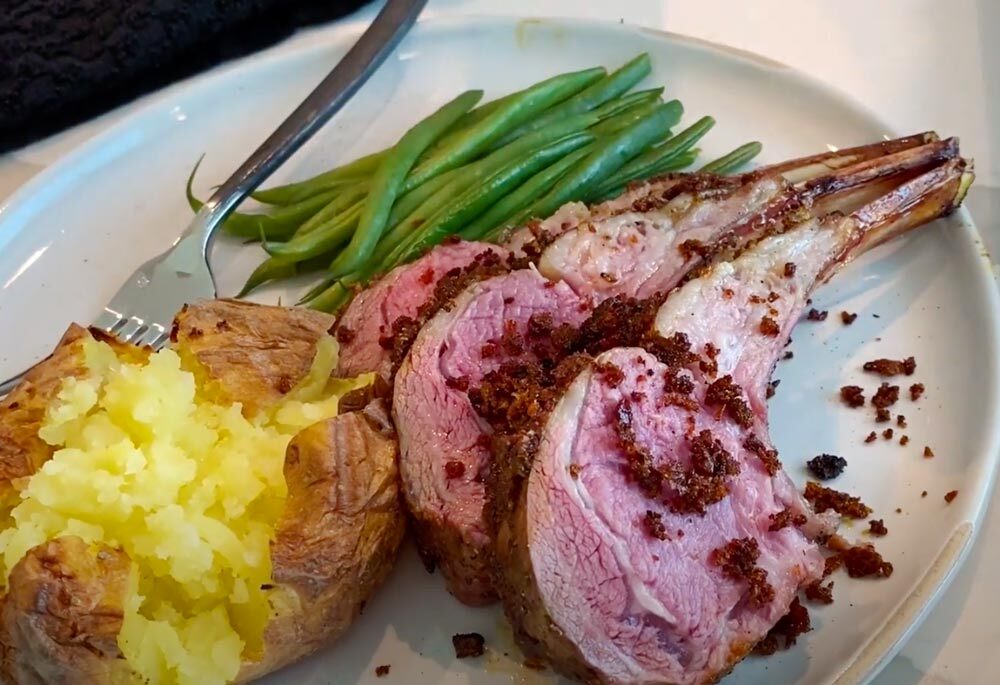
These cigar-shaped filled pastries are a Turkish specialty, traditionally made with sheets of a thin dough called yufka. I find that phyllo, which is very similar to yufka, makes the perfect wrapper—it crisps up nicely and really lets the lamb filling be the star. For appetizer portions, cut the boreks into bite-sized pieces just before serving.
Ingredients
3 tablespoons extra virgin olive oil, plus more for the phyllo
2 cups diced yellow onion
1 1/4 pounds ground lamb
1 1/2 teaspoon black Urfa chili or red pepper flakes
1/2 teaspoon dried oregano
1 teaspoon cinnamon, preferably Vietnamese
2 teaspoons black lime
1 tablespoon honey
1/2 cup raisins, sultanas if possible, roughly chopped
1/2 cup unsalted pistachios, roughly chopped
Coarse sea salt
Freshly ground black pepper
2 cups plain Greek yogurt
3 eggs
4 tablespoons chopped fresh parsley
16-18 phyllo dough sheets, defrosted if bought frozen
3 tablespoons poppy seeds
Directions
Step 1
Heat the 3 tablespoons of olive oil in a large skillet. Sauté the onions until soft and golden. Add the ground lamb and cook, stirring constantly. Just before the lamb is fully cooked through, fold in the Urfa chili, oregano, cinnamon, black lime, honey, raisins, and pistachios. When the lamb is done, remove from heat and taste. Season with salt and pepper as desired. Set aside to cool to room temperature. If there’s any liquid in the pan with the lamb, use a slotted spoon to transfer the mixture to a large bowl—liquid can cause the phyllo to tear.
Step 2
Preheat your oven to 350°F. Line a large rimmed baking sheet with parchment paper or a Silpat mat. Place the yogurt in a medium bowl. In a small bowl, beat two of the eggs with a whisk or fork and then fold into the yogurt along with the parsley. Beat the remaining egg in a separate bowl and set aside next to the poppy seeds.
Step 3
Set out a large piece of parchment paper on a countertop and place a sheet of phyllo dough on top of it. Lightly brush the phyllo with olive oil (you may need to dab rather than brush if the phyllo tears easily—don’t worry about small tears because they’ll be rolled up). Quickly place a second sheet of phyllo directly on top of the first and brush with more oil. Fold the double sheet in half and spread with a thin layer of the yogurt mixture, leaving a 1-inch border on all sides. Spoon a scant half-cup of the lamb mixture in a line along one of the short sides, about 2 inches in from the short edge and from both long sides. Turn in the longer sides about 2 inches so that they cover the outer edges of the lamb mixture, and brush the exposed phyllo with more oil. Fold the short edge of phyllo over the lamb and then roll it up into a cigar-like shape, brushing the phyllo with oil as you go. Place the borek on your baking sheet and cover with a kitchen towel. Repeat with the remaining phyllo sheets and lamb, placing them at least 2 inches apart.
Step 4
Once you’ve made all the boreks, brush them with the beaten egg and sprinkle with the poppy seeds. Bake for about 35 minutes or until the phyllo is browned and crispy.
Forget sauces and sprinkles. Vibrantly fresh extra virgin olive oil enhances these sophisticated sundaes.
Ingredients
2 oranges
1/2 cup plus 2 tablespoons granulated sugar
1/2 cup water
2 pints homemade or best-quality packaged vanilla ice cream
Flaky sea salt, such as Maldon salt
Extra virgin olive oil
Directions
Remove the zest from both oranges with a bartender’s zester, which removes it in long strips. Alternatively, make wide strips with a sharp paring knife, peel them away from the sections, cut away any excess pith, and slice them into long slivers. Bring the 1/2 cup of sugar and the water to a rapid boil in a small, heavy saucepan over medium heat. Let it boil for 5 minutes, and then add the zest strips. Reduce heat to a simmer and cook until the strips are translucent, about 15 minutes. Drain in a colander. You can reserve the flavored syrup for another use, such as sweetening tea or drizzling over a loaf cake. Toss the zest strips with the remaining 2 tablespoons of sugar (a resealable plastic bag works well for this) and set them on a rack to dry for a half hour or longer.
When you’re ready to serve the sundaes, place a scoop of ice cream in each of 6 highball glasses or ice cream dishes. Make a depression in each scoop with the back of a spoon. Drizzle with a little olive oil, then top with a tangle of candied zest and a pinch of the flaky salt. Repeat all the layers in each dish—a second scoop of ice cream, olive oil, zest, and sea salt. Serve at once.
The following recipe features a marinade of mojo, the Cuban classic built on a base of olive oil, citrus, and garlic. I like to double the salsa ingredients to have some as a dip for chips or for another dish the next day.
Ingredients
For the marinade:
1 teaspoon ground cumin
4 garlic cloves, crushed
1 jalapeño, seeded and chopped
1/4 teaspoon coarse salt
3 tablespoons extra virgin olive oil
3 tablespoons fresh lime juice
3 tablespoons fresh orange juice
2 tablespoons gourmet vinegar
3 pounds skinless chicken thighs
For the salsa:
2 tablespoons extra virgin olive oil
2 tablespoons gourmet vinegar
1/4 cup fresh orange juice
2 teaspoons orange zest
2 teaspoons lime zest
1 teaspoon honey
1 teaspoon soy sauce
4 tablespoons butter, cubed
2 ripe mangos, peeled, pitted, and diced
2 ripe avocados, peeled, pitted, and diced
3 tablespoons chopped fresh cilantro
Directions
Step 1
Marinate the chicken: In a food processor, pulse the cumin, garlic, jalapeño, and salt into a paste, and then drizzle in the olive oil, the juices, and vinegar. Place the chicken in a large bowl, pour in the marinade, rotate it to distribute the marinade, and cover. Refrigerate for 3 hours or overnight.
Step 2
An hour before you’re ready to grill the chicken, prepare the salsa. In a medium saucepan, whisk the oil, vinegar, juice, zests, honey, and soy sauce and bring to a boil. Lower the heat and simmer until reduced by half. Remove from the heat and whisk in the butter. Place the mangos and avocados in a bowl and drizzle with the reduced sauce. Gently fold to coat the fruits, and then sprinkle with the cilantro; set aside.
Step 3
Grill the chicken until it reaches an internal temperature of 165°F. Transfer to a platter and spoon on half the salsa, serving the rest on the side.
The Essential Fra Diavolo Sauce Recipe, Olive Oil’s Role in a Plant-Based Diet and The Benefits of Olive Oil for Heart Health
Did you know that many chefs—including me!—prefer using canned tomatoes rather than fresh ones when making sauce? All the prep work has been done for you, so they’re a huge time saver as well as being flavorful. This week’s recipe for deliciously zesty fra diavolo sauce capitalizes on this pantry essential. I’m also sharing news about the heart health benefits of olive oil. A wealth of studies have found that it helps stave off heart disease and that the sooner you starting using it, the healthier you’ll be in the decades to come.
This Italian classic often gets its heat from pepperoncino (red pepper) flakes, but I love the depth that comes from including fresh serrano pepper in the garlic and onion sauté. For another layer of flavor, I use a full can of tomato paste. So delicious, plus you can make it your own with any seafood you like—go simple with shrimp, lavish with lobster tail meat and scallops or easy with chunks of your favorite fish!. As a final step to this recipe, you might stir in a pound of shelled shrimp and cook until opaque. Serve it with or without pasta. It’s also delicious with any legume-based pasta—top with a good amount of grated Parmesan or Pecorino.
Ingredients
3 tablespoons extra virgin olive oil, more as needed
2 pounds assorted seafood, such as 8 ounces each peeled shrimp, scallops, calamari rings, and crabmeat
½ cup finely chopped onion
1 serrano pepper, seeded and chopped
4 large garlic cloves, peeled and chopped
1 6-ounce can tomato paste
½ cup red wine
1 28-ounce can crushed tomatoes
½ teaspoon dried oregano
Pinch of salt
Directions
Step 1
Heat a large skillet—it’s ready when a few drops of water sizzle on the surface. Add the olive oil and then the seafood, gently searing it on all sides. With a slotted spoon, transfer the seafood to a bowl next to your cooktop. Add more oil to the pan if needed, then add the onions and sauté until soft and translucent, but not browned.
Step 2
Add the pepper and garlic and cook until soft. Then add the tomato paste and cook it until fragrant and almost brown-burgundy in color, whisking it constantly as it caramelizes. Slowly whisk in the wine and then add the crushed tomatoes, oregano, and salt, and heat through.
Step 3
Return the seafood to the pan and cook for 3–4 minutes until cooked through. Serve over your choice of pasta.
Yields 4 servings
Olive Oil’s Role in a Plant-Based Diet
Building out healthy eating
The research: “A Plant-Centered Diet and Risk of Incident Cardiovascular Disease during Young to Middle Adulthood” and “Relationship Between a Plant-Based Dietary Portfolio and Risk of Cardiovascular Disease: Findings from the Women’s Health Initiative (WHI) Prospective Cohort Study,” Journal of the American Heart Association, August 2021.
As much as you love fresh-pressed olive oil, it shouldn’t be the only item on your healthy menu. These two new studies both looked at the heart benefits of eating a plant-centered diet—not necessarily vegetarian, but with a foundation of fruits, vegetables, olive oil, nuts, whole grains, and legumes.
One looked at the advantages of starting such a way of eating younger in life. It followed 4,946 adults from the Coronary Artery Risk Development in Young Adults (CARDIA) study for about 30 years. Participants went through lab tests, physical measurements, medical histories, assessments of lifestyle factors, and detailed diet history interviews. Researchers used a scoring system called A Priori Diet Quality Score (APDQS) to assess the participants’ diets. APDQS classifies food groups as beneficial (like fruits, vegetables, beans, nuts, and whole grains), adverse (like fried potatoes, high-fat red meat, salty snacks, pastries, and soft drinks), and neutral foods (like potatoes, refined grains, lean meats, and shellfish) based on the foods’ known links with cardiovascular disease.
People who scored in the top 20% for diet quality by eating the most beneficial foods and fewer adverse ones were 52% less likely to develop cardiovascular disease. Also, between years 7 and 20 of the study, when participants ranged in age from 25 to 50, those who improved their diet quality the most were 61% less likely to develop cardiovascular disease later on than those whose diet quality declined the most during that time.
The other study looked at the heart health effects of an eating program called the Portfolio Diet. It followed 123,330 postmenopausal women from the Women’s Health Initiative, a long-term national study, for 25 years. The Portfolio Diet includes nuts; plant protein from soy, beans, or tofu; soluble fiber-rich oats; barley; okra; eggplant; oranges; apples and berries; olive oil; canola oil; and avocados, with limited saturated fats and cholesterol, an approach already found to lower unhealthy LDL cholesterol.
Based on the participants’ answers to questionnaires, the researchers found that the women who followed the Portfolio Diet more closely were 11% less likely to develop any type of cardiovascular disease, 14% less likely to develop coronary heart disease, and 17% less likely to develop heart failure than the women who followed it the least.
“These results present an important opportunity, as there is still room for people to incorporate more cholesterol-lowering plant foods into their diets. With even greater adherence to the Portfolio dietary pattern, one would expect an association with even less cardiovascular events, perhaps as much as cholesterol-lowering medications,” said senior study author John Sievenpiper, MD, PhD, of St. Michael’s Hospital, in Ontario, Canada, and associate professor of nutritional sciences and medicine at the University of Toronto.
“We also found a dose response in our study, meaning that you can start small, adding one component of the Portfolio Diet at a time, and gain more heart-health benefits as you add more components,” said lead author Andrea J. Glenn, PhD, RD, now an instructor at York University in Toronto.
The Benefits of Olive Oil for Heart Health
Even small amounts make a big difference
The research: “Olive Oil Consumption and Cardiovascular Risk in U.S. Adults,” Journal of the American College of Cardiology, April 2020.
This study looked at one of the most important benefits of olive oil: its link to helping lower heart disease risk. What sets it apart from previous studies is that the participants were Americans; most previous large studies involved people living in the countries surrounding the Mediterranean Sea, where olive oil consumption is much higher than it is here. The aim was to compare the effects of olive oil on heart health to those of margarine, butter, mayonnaise, and dairy fat.
The researchers analyzed diet and lifestyle data from 61,181 women who were part of the Nurses’ Health Study and 31,797 men who took part in the Health Professionals Follow-up Study and who filled out questionnaires every four years between 1990 and 2014. The study found that participants who had anywhere over a half tablespoon of olive oil each day in place of the other fats had a 15% lower risk of having any kind of cardiovascular disease and a 21% lower risk of coronary heart disease. This led them to conclude that replacing even small amounts of animal fat with olive oil could move the needle toward a healthier heart. More information from a smaller pool of the participants showed that higher olive oil intake was also linked with lower levels of several inflammatory biomarkers and higher levels of HDL cholesterol—the good kind.