Fresh-Pressed Olive Oil Club

The Olive Oil Hunter News #18

Maiale con Salsa Verde (Pork with Green Sauce) Recipe, Spotlight on Parsley, Boosting Flavor with Leftovers, and Learn More About Resveratrol

One of the things I love most about traveling the globe is tasting how each cuisine puts its own spin on the universal foods we love—breads, dumplings, sausages…and green sauce! Some cuisines, such as Mexican salsa verde and Argentinian chimichurri, are known the world over, while others are waiting to be discovered. To my delight, on one of my many trips to Italy, I experienced their version, redolent with anchovy and capers—so delizioso that I’m sharing it with you here. It’s so versatile, too, delicious on all types of meat and seafood. Let it inspire you to try your hand at creating your own herb-based sauces—the basic elements are leafy herbs such as parsley or cilantro, onions or garlic, olive oil, and an acid such as lemon juice or vinegar, plus spices that include one form or another of red pepper for a nice kick.

Italian cuisine is synonymous with pasta and pizza, but pork is also a favorite in Italy. Pork tenderloin is the leanest cut of the pig, on a par with skinless chicken breasts. Because tenderloins have little fat and typically weigh only a pound, they cook quickly and can quickly dry out if they cook too long, so set your timer as soon as you pop them into the oven.

Maiale con Salsa Verde/Pork with Green Sauce
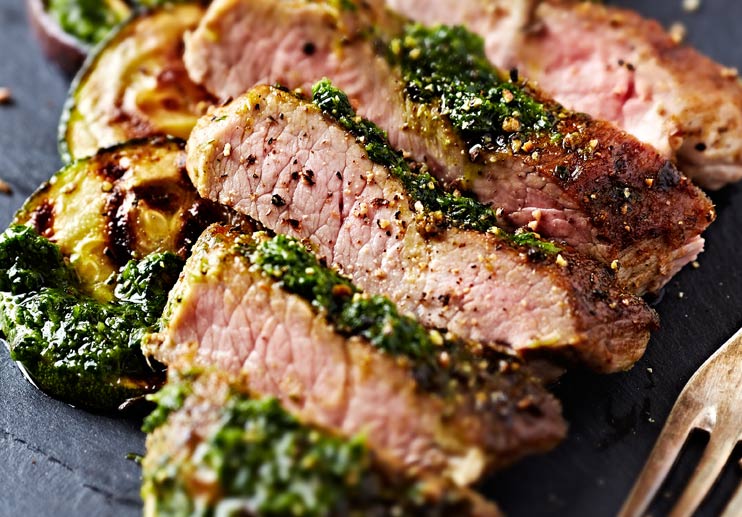
  • The Olive Oil Hunter News #18 Maiale con Salsa Verde/Pork with Green Sauce

    Italian cuisine is synonymous with pasta and pizza, but pork is also a favorite in Italy. Pork tenderloin is the leanest cut of the pig, on a par with skinless chicken breasts. Because tenderloins have little fat and typically weigh only a pound, they cook quickly and can quickly dry out if they cook too long, so set your timer as soon as you pop them into the oven.

    Ingredients

    For the pork:

    • 2 pork tenderloins, about 1 pound each
    • Extra virgin olive oil
    • Coarse salt to taste
    • Coarsely ground black pepper to taste

    For the salsa verde:

    • 1 cup flat-leaf parsley leaves, packed
    • 1 anchovy fillet, coarsely chopped
    • 1 to 2 cloves garlic, peeled and coarsely chopped
    • 1-1/2 tablespoons drained brined capers
    • 1 tablespoon lemon juice
    • 1/4 teaspoon crushed red pepper flakes
    • 1/3 cup extra virgin olive oil
    • Coarse salt to taste
    • Coarsely ground black pepper to taste

    Directions

    Step 1

    Preheat your oven to 400°F. Trim off any fat and silverskin from the pork tenderloins and rub all sides with extra virgin olive oil. Season generously with salt and pepper. Heat a tablespoon of olive oil in a large cast iron or other oven-proof skillet over medium-high heat. Sear the tenderloins until nicely browned, about 2 minutes per side, 8 minutes in all. Place the skillet with the meat in the oven. Roast the tenderloins until the internal temperature registers 145°F, about 10 to 12 minutes or as needed. (The meat will still be slightly pink inside. Roast longer if you prefer your pork more done, but don’t overdo.) Let cool slightly before slicing.

    Step 2

    To make the salsa verde, combine all the ingredients in a blender or food processor and run the machine until the ingredients are well combined.

    Step 3

    Carve the pork tenderloin into 1/2-inch slices and arrange them on a platter. Drizzle some of the sauce over the meat and pass the rest.

    Yields 6 servings.

Healthy Ingredient Spotlight: Parsley

Healthy Ingredient Spotlight

Parsley

Parsley is one of the unsung heroes of the herb garden. Of course, I mean flat leaf or Italian parsley, not the curly leaf variety, which has very little flavor. It’s a disservice to parsley to treat it as a garnish to brighten a plate since it can really brighten the food itself. It makes the perfect base for many sauces and dressings and is a great finishing touch to chicken and pasta dishes when it’s incorporated during the last minute of cooking. A key ingredient in the Middle Eastern classic tabbouleh, parsley can be a tasty addition to most salads, not only because of its flavor but also because of its nutrients. Parsley is a rich source of vitamin K and a good source of vitamins A and C. It has fewer than 4 carbs per cupful, and half of them are fiber (that means only 2 net carbs!). When parsley is fresh, you’ll be able to easily inhale its aroma, which is milder than the other great flat-leaf herb, cilantro.

Healthy Kitchen Tip: Flavor-Boosting with Anchovies

Healthy Kitchen Nugget

Flavor-Boosting with Anchovies

Wondering what to do with leftover anchovies? Think of an anchovy fillet as a flavor booster—it won’t add a fishy taste. Caesar salad dressing isn’t the only dressing that benefits from anchovies—add a fillet to the mix the next time you whip up your favorite recipe. But don’t stop there. Add an anchovy to the pan when you sauté garlic or onions, especially when building flavors for a rich tomato sauce. For ease of use, buy jarred rather than canned anchovies. But if you find that you really only use them occasionally, get a tube of anchovy paste instead. Like tomato paste in a tube, it’s handy when you only need a small amount. A half teaspoon of paste equals one whole anchovy.
For Your Best Health: Resveratrol

For Your Best Health

Resveratrol

A blog post from Joe Schwarcz, PhD, director of McGill University’s Office for Science and Society, whose mission is “separating sense from nonsense,” may have you reevaluating your wine intake. Dr. Schwarcz puts into perspective all the hoopla surrounding resveratrol, the compound in grapes and red wine that has been looked at for potential anti-cancer and heart-health properties. Cell cultures and research on rodents, worms, and the like has shown benefits, but even if resveratrol had all the same effects on people, we would need to drink “about a hundred bottles of wine to approach the amount of resveratrol fed to the mice,” writes Dr. Schwarcz.

Is the answer then to take the resveratrol supplements that have flooded the market? “More than 20,000 papers later, in spite of the plethora of laboratory and animal studies, human clinical trials, and speculation about theoretical mechanisms of action, it is still not possible to say yay or nay about taking resveratrol supplements. On the positive side, there have been no safety issues with doses as high as 5 grams. That’s comforting because if there is to be any beneficial effect from resveratrol, it will have to come from supplements. At some point, I wish we could end such articles with something other than ‘more research is needed,’ but unfortunately, this is not that time. As far as that glass of wine with supper goes, there is a good reason for drinking it. The taste. And the pleasant after-effects,” Dr. Schwarcz concludes. You can read the entire post here.

Fitness Flash: The Tremendous Benefits of Exercise

Fitness Flash

The Tremendous Benefits of Exercise

Exercise Is Medicine® is an initiative launched back in 2007 by the American College of Sports Medicine (ACSM) and the American Medical Association to make physical activity and exercise a standard part of disease prevention and treatment in the US, and to encourage primary care physicians to include exercise when designing treatment plans for patients. But, all these years later, too many annual doctor visits don’t even touch on the subject.

That’s unfortunate considering the tremendous health benefits seen with even low levels of exercise—as ACSM points out, the amount of exercise needed to benefit health is much lower than the amount needed for fitness (though that should be a goal, too!). Regular exercise at moderate to high intensity reduces the risk of heart disease by 40%, stroke by 27%, and the incidence of diabetes and of high blood pressure by almost 50%. It can lower the risk for certain cancers and of developing Alzheimer’s disease as well as decrease depression as effectively as Prozac or therapy. All this means that you shouldn’t leave your next doctor visit without getting an assessment of your current physical activity level and an appropriate prescription for an exercise program or a referral to a qualified fitness professional who can design one for you.

If you want a preview of how ready you are to exercise on your own, check out the Physical Activity Readiness Questionnaire, with its general and follow-up health questions. Use your results to initiate a conversation on exercise with your doctor.

Get More Recipes In Your Inbox!

The Olive Oil Hunter News #6

Grilled Skirt Steak with Salsa Verde Recipe, Spotlight on Indoor Herb Gardens, the Power of Protein-Rich Foods and Weight Training

Americans have had a love affair with the backyard grill for nearly 100 years, and you have carmaker Henry Ford to thank. Back in the day, wood was used in various components of the Model T, and the milling left quite a lot of scrap. Ford found a way to capitalize on the waste, using a formula developed by a chemist for combining it with tar and cornstarch and turning it into lumps. Ford marketed the new product as briquettes, and they were soon being sold in grilling kits at car dealerships, adding another facet to the adventurous American lifestyle he had pioneered. 

As grilling (and smoking) meat has been elevated to a culinary art, many chefs have turned to natural hardwoods, not just as a flavor enhancer but also as a full alternative to Ford’s invention. I prefer hardwood lump charcoal to briquettes because they don’t contain any additives. Above all, you want to stay away from briquettes labeled “fast-starting” because they contain lighter fluid—in fact, lighter fluid shouldn’t have any place in grilling. (The Healthy Kitchen Nugget below has more on how to use hardwood.)

Grilled Skirt Steak with Salsa Verde

  • The Olive Oil Hunter News #6 Grilled Skirt Steak with Salsa Verde

    If you love to grill like I do, you probably don’t limit yourself to summer BBQs. Here’s a perfect dish for a crisp fall evening.

    Ingredients

    For the salsa verde:
    • 1-1/2 cups packed flat-leaf parsley 
    • 2/3 cup extra virgin olive oil
    • 1/4 cup capers, drained
    • 1 to 2 anchovy fillets (optional) 
    • 1 tablespoon white wine vinegar
    • 2 medium cloves garlic, minced (about 2 teaspoons) 
    • 1 tablespoon lemon juice 
    • 1/2 teaspoon freshly grated lemon zest 
    • Kosher salt 
    • Freshly ground black pepper 

    For the steak: ​

    • One 2-pound skirt steak
    • Kosher salt
    • Freshly ground black pepper 

    Directions

    Step 1

    To make the salsa verde, roughly chop the parsley and place it, along with the olive oil, capers, anchovies (if using), vinegar, garlic and lemon juice and zest, in the work bowl of a food processor fitted with a steel blade. Pulse until the parsley is well chopped, stopping to scrape down the sides of the bowl as necessary. Season with salt and pepper to taste. Transfer to a gravy boat or a small bowl and set aside. 

    Step 2

    Set up your grill or grill pan for indirect grilling, and heat it to medium-high. Generously season both sides of the steak with salt and pepper. Grill for about 3 minutes per side, or until done to your liking. Let rest for 2 minutes before carving thinly against the grain. Serve with the salsa verde.

    Quick kitchen hack: Carving the right way is key with certain cuts of meat, like skirt or flank steak. Whether you see it described as “on the diagonal,” “on a bias” or “against the grain,” it means the same thing—slicing in the direction opposite the meat’s muscle fibers. So, if you’re looking at your steak and the fibers are running vertically from top to bottom, you want to slice horizontally or across from side to side. The reason is simple: This creates a more tender chew.

Healthy Ingredient Spotlight: Quick Croutons to garnish homemade meals

Healthy Ingredient Spotlight

Indoor Herb Gardens

If your outdoor herb garden is nearing its end or if you don’t have one at all, it’s time to start growing herbs indoors. Parsley for my salsa verde is a great first choice, and then consider basil, cilantro and rosemary for a versatile mix. 

All you need are a few steps to replicate the outdoor conditions that herbs like. Because even a sunny windowsill doesn’t get a full 14 or so hours of summer-style daylight once fall arrives, grow lights are a great help. You can get a simple floor or desk model to shine on your plants or go full board with a stacking modular shelf and light system that can support racks of plants (to see one example, check out gardeners.com).

Starting new plants from seeds will give them a healthy advantage if you think you’ll move them outdoors come spring. But it’s easier (and faster) to buy small transplants if you want a head start. According to University of Maryland Extension, a good rule of (green) thumb is to use two parts of soilless potting mixture and one part of perlite. If space allows, grow each herb in its own pot—that way, you can water each one with the right frequency. Make sure your containers have drainage holes and sit in a dish or tray to catch any excess water. Keep your plants away from drafts as well as heat vents. Mist them every day to create some humidity, especially if the air in your home is dry. Be patient before cutting in order to give your herbs time to take hold. And when you do clip some sprigs, resist taking more than a third of the plant at one time. Find out more here.

Healthy Kitchen Tip: Chimney Starter

Healthy Kitchen Nugget

Grilling Tip: Chimney Starter

My friend Steven Raichlen, the ultimate grill master, has an amazing website called barbecuebible.com, where he details the best ways to get your grill fire going. The secret is a chimney starter, a metal cylinder or box with two sections, one for the charcoal and the other for a wad of newspaper. Place the loaded chimney starter on the bottom grate of your grill, light the newspaper and, in 15 to 20 minutes, the charcoal will be ready to go.

For Your Best Health: Protein-Rich Foods

For Your Best Health

Protein-Rich Foods

Protein-rich foods don’t just taste great, but they’re also the body’s building blocks, keeping muscles strong and helping us stay vital and independent. But did you know that our protein needs increase as we get older and that eating more of it has many benefits? 

One study, published in the journal Nutrients, found that people who eat between 20% and 50% more than the standard suggested daily amount (that’s technically .36 grams for every pound you weigh) have greater lower-body strength and a faster walking speed. 

Another study, published in the Journal of Alzheimer’s Disease, compared protein intake among its participants and found that those who ate the most protein had less risk of developing Alzheimer’s than those who ate the least. The researchers pegged an ideal amount at about 120 grams of protein a day. 

The top highest protein-rich foods are lean beef, pork, lamb, turkey, chicken, fish and shellfish, with about 7 grams per ounce; eggs, with 6 grams each; edamame, lentils and beans, with 8-9 grams per half cup; milk and yogurt, with about 8 grams per 8 ounces; and nuts, with 4-6 grams per ounce, according to Hopkins Medicine.

Fitness Flash: Weight Training

Fitness Flash

Weight Training

Diet is only one part of the health equation. Exercise is the other. While cardio workouts are vital, you might not be getting the weight training that you need for optimal strength. If the idea of working out with weights doesn’t appeal to you, research published in Sage Open Medicine points out that resistance bands can be just as effective. And a research review in the journal Sports Medicine found that we can get great gains, particularly in arms and legs, from these stretchy pieces of elastic, even later in life. The bands come in a variety of tensions, so you can easily increase the difficulty as you gain strength to keep those gains coming.

Get More Recipes In Your Inbox!

How to (O)live Longer

Some olive oils fight heart disease and cognitive decline. But to get the greatest benefit, you need to pick the right stuff

Reprinted from an article in AARP Bulletin by Clint Carter, April 2020

In normal times, Italians outlive Americans by an average of four years. But in the Sicani Mountain region of Sicily, marked by rolling hills covered with olive trees, the locals live past 100 at a rate more than four times greater than Italy as a whole.

Sicani Mountain villagers eat a Mediterranean diet, snacking on olives and using the fruit’s oil to prepare dinner. As a result, their arteries are as supple as those of people 10 years younger, researchers say.

“We’ve known for 50 or 60 years that the Mediterranean diet is beneficial for health, but olive oil is emerging as the most important ingredient,” says Domenico Praticò, MD, director of the Alzheimer’s Center at Temple University. Among people in olive-growing regions, the incidences of heart disease, cancer, type 2 diabetes, and even cognitive decline are very low.

How Olive Oil Offers Hope

Praticò and others have been exploring the effect of extra-virgin olive oil, or EVOO, on the brain. They’ve discovered that compounds in the fat of this high-grade oil can flush out proteins that gum up the communication channels between brain cells. That might delay, and even possibly reverse, Alzheimer’s and other dementias.

One compound that seems to drive this effect is an olive-derived polyphenol called oleocanthal. In animal studies at Auburn University, oleocanthal demonstrated an ability to “rinse out” amyloids, which form the plaques associated with Alzheimer’s. In mice EVOO can “flush out” tau, a protein that hinders language skills and memory in humans.

Buyer, Beware!

But not all the EVOO sold at the supermarket is as potent as the oil that researchers use to “flush out” neurotoxins. In lab tests more than half of imported EVOO purchased at retail failed to meet standards of quality and flavor (a marker of antioxidant content) established by the Madrid-based International Olive Council. In a 2015 analysis from the National Consumers League, 6 in 11 EVOOs obtained from reputable stores such as Safeway and Whole Foods failed the extra virgin test. They were either mislabeled or had degraded during shipping and storage. So what does all this mean? You need to know a few shopping tricks if you want to get all the protection that EVOO offers to the centenarians of the Sicani Mountains.

Study shows extra virgin olive oil staves off multiple forms of dementia in mice

Adapted from an article in Science Codex by the Temple University Health System, November 25, 2019

Boosting brain function is key to staving off the effects of aging. And if there was one thing every person should consider doing right now to keep their brain young, it is to add extra virgin olive oil (EVOO) to their diet, according to research by scientists at the Lewis Katz School of Medicine at Temple University (LKSOM).

Previous LKSOM research on mice showed that EVOO preserves memory and protects the brain against Alzheimer’s disease.

In a new study in mice published online in the journal Aging Cell, LKSOM scientists show that yet another group of aging-related diseases can be added to that list—tauopathies, which are characterized by the gradual buildup of an abnormal form of a protein called tau in the brain. This process leads to a decline in mental function, or dementia. The findings are the first to suggest that EVOO can defend against a specific type of mental decline linked to tauopathy known as frontotemporal dementia.

Alzheimer’s disease is itself one form of dementia. It primarily affects the hippocampus—the memory storage center in the brain. Frontotemporal dementia affects the areas of the brain near the forehead and ears. Symptoms typically emerge between ages 40 and 65 and include changes in personality and behavior, difficulties with language and writing, and eventual deterioration of memory and ability to learn from prior experience.

Senior investigator Domenico Praticò, MD, describes the new work as supplying another piece in the story about EVOO’s ability to ward off cognitive decline and to protect the junctions where neurons come together to exchange information, which are known as synapses.

“The realization that EVOO can protect the brain against different forms of dementia gives us an opportunity to learn more about the mechanisms through which it acts to support brain health,” he said.

In previous work using a mouse model, in which animals were destined to develop Alzheimer’s disease, Dr. Praticò’s team showed that EVOO supplied in the diet protected young mice from memory and learning impairment as they aged. Most notably, when the researchers looked at brain tissue from mice fed EVOO,

they did not see features typical of cognitive decline, particularly amyloid plaques—sticky proteins that impair communication pathways between neurons in the brain. Rather, the animals’ brains looked normal.

The team’s new study shows that the same is true in the case of mice engineered to develop tauopathy. In these mice, normal tau protein turns defective and accumulates in the brain, forming harmful tau deposits, also called tangles. Tau deposits, similar to amyloid plaques in Alzheimer’s disease, block neuron communication and thereby impair thinking and memory, resulting in frontotemporal dementia.

Tau mice were put on a diet supplemented with EVOO at a young age, comparable to about age 30 or 40 in humans. Six months later, when mice were the equivalent of age 60 in humans, tauopathy-prone animals

experienced a 60 percent reduction in damaging tau deposits, compared to littermates that were not fed EVOO. Animals on the EVOO diet also performed better on memory and learning tests than animals deprived of EVOO.

Dr. Praticò and colleagues now plan to explore what happens when EVOO is fed to older animals that have begun to develop tau deposits and signs of cognitive decline, which more closely reflects the clinical scenario in humans.

Reference: Lauretti E, Nenov M, Dincer O, Iuliano L, Praticò D. Extra virgin olive oil improves synaptic activity, short-term elasticity, memory, and neuropathology in a tauopathy model. Aging Cell. 2020;19(1):e13076.