
Winter Salad Recipe, Spotlight on Homemade Vinaigrettes, Prepping Greens, A New Benefit of Vitamin D, and Aerobics for Knee arthritis
Salads aren’t just for summer, and if one of your New Year’s resolutions is to eat more fruits and veggies, this winter greens recipe fits the bill. I’ve dressed it with a sweet-tart vinaigrette that you can use with a variety of foods for lighter eating. I’m also sharing two new important findings: how vitamin D can help people avoid a second heart attack and a surprising way to manage knee arthritis.
Winter Salad
 Winter Salad
Using sweet and tart vinegars adds complexity to this vinaigrette, which is a delicious foil for the slightly bitter greens and sweet pears.
Ingredients
For Vinaigrette:
- 1 tablespoon red wine vinegar, such as Austrian Red Wine Vinegar
- 1 tablespoon balsamic vinegar of Modena, such as Condimento Barili Exclusivi
- 1/2 tablespoon Dijon mustard
- 1/2 tablespoon honey
- 1/4 teaspoon coarse sea salt, plus more to taste
- 1/2 garlic clove, minced
- 1/3 cup extra virgin olive oil
- Freshly ground black pepper to taste
For the Salad:
- 1/2 cup hazelnuts or walnut halves
- 4 to 6 cups baby spinach, baby kale, escarole, or other winter greens, rinsed and dried
- 2 ripe pears, cored and thinly sliced
- Block of Parmigiano-Reggiano or 2 ounces mild blue cheese
Directions
Step 1
Make the vinaigrette: In a medium mixing bowl, whisk together the vinegars, mustard, honey, salt, and garlic. Gradually whisk in the olive oil until the dressing is emulsified. Season to taste with pepper and more salt, if desired.
Step 2
Make the salad: Heat a small sauté pan. When hot, add the nuts and toast for 2 minutes until they become fragrant, tossing frequently; set aside.
Step 3
Divide the greens among 4 salad plates and top with equal amounts of pear slices and nuts. If using Parmigiano-Reggiano, use a cheese plane to make long shavings over each salad. If using blue cheese, crumble it. Drizzle a spoonful of vinaigrette over each salad and pass the rest on the side.
Yields 4 servings

Healthy Ingredient Spotlight
Homemade Vinaigrettes
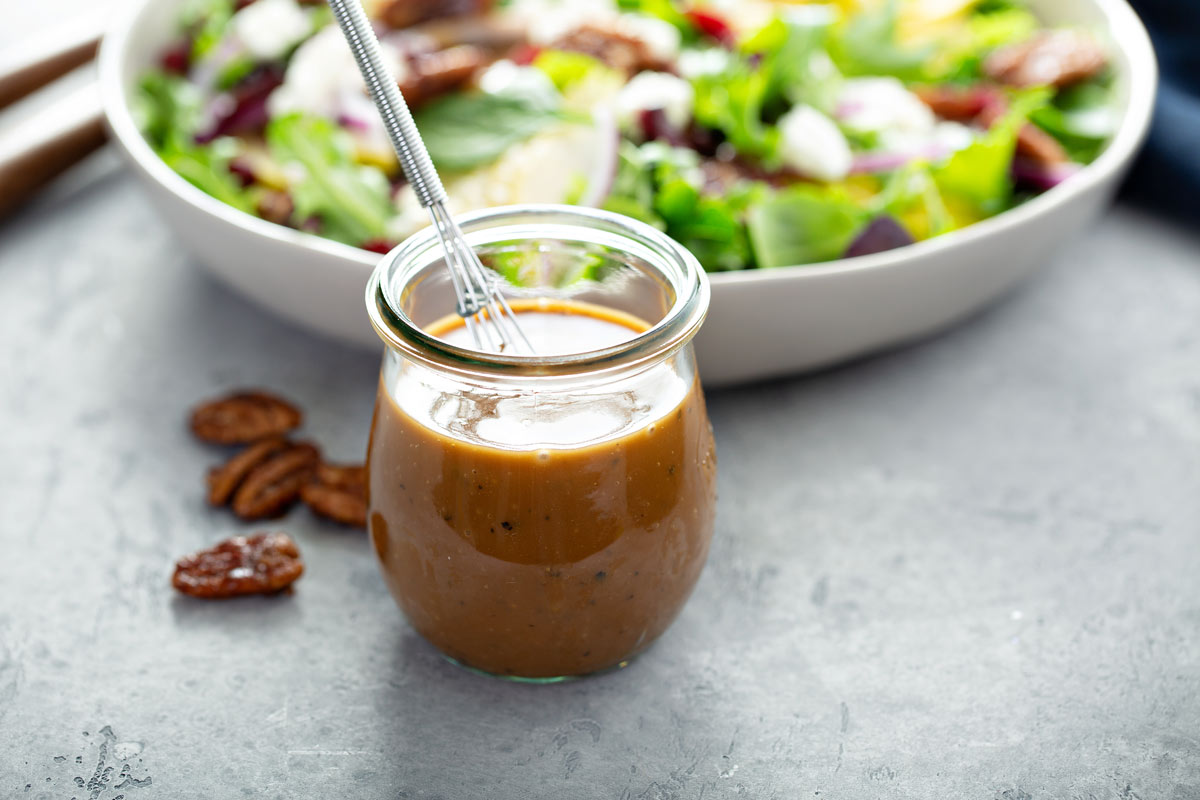
It’s no secret that most bottled dressings are loaded with sugar, artificial ingredients, and poor- quality oil. On the other hand, it’s so easy to make your own with just a few quality ingredients. Vinaigrettes can be made with a whisk, but using a blender or mini food processor can make fast work of it, especially if some ingredients need to be chopped or minced. As a general rule, you can pulse all the ingredients except the olive oil for a few seconds—let the machine mince any herbs, garlic, or shallots for you. Then with the machine still running, slowly add the olive oil through the feed tube until the vinaigrette is emulsified. Vinaigrette will keep for up to a week in the fridge; shake well or whisk as needed before using.

Quick Kitchen Nugget
Prepping Greens
To maximize taste when making salads, prep your greens by rinsing and drying them in a salad spinner or with an absorbent kitchen towel—dressing coats them better when they’re dry and won’t be diluted by water clinging to the leaves. Rather than simply pouring vinaigrette over your salad, mix it in with two forks or tongs to really dress the greens. Also, keep in mind that vinaigrettes aren’t just for salads—drizzle them over roasted vegetables, grains, and cold meats.

For Your Best Health
A New Benefit of Vitamin D
In a large randomized clinical trial, researchers from Intermountain Health in Salt Lake City found that managing the vitamin D levels of people who experienced a heart attack through a “target-to-treat” approach, with blood levels monitored and dosages adjusted to reach an optimal range, cut the likelihood of a second heart attack by 50%. The findings were presented on Nov. 9 at the 2025 American Heart Association Scientific Sessions in New Orleans.
According to researchers, the results carry global importance, as between one-half and two-thirds of people worldwide have low levels of vitamin D. In the past, most individuals received sufficient vitamin D through sunlight exposure. Today, with lifestyle changes and medical advice aimed at reducing skin cancer risk, people spend less time in the sun and must rely more on dietary supplements such as vitamin D3 to maintain healthy levels.
Low vitamin D levels have long been linked to poor cardiovascular outcomes in observational studies. However, earlier clinical trials that provided standard supplementation doses failed to show measurable reductions in heart disease risk. Intermountain scientists wanted to test a different idea: Rather than giving everyone the same dose, what if supplementation was adjusted to reach a specific healthy vitamin D level?
“Previous studies just gave patients supplementation without regularly checking blood levels of vitamin D to determine what supplementation achieved,” said Heidi May, PhD, cardiovascular epidemiologist at Intermountain and the study’s principal investigator. “With more-targeted treatment, when we checked exactly how supplementation was working and made adjustments, we found that patients had their risk of another heart attack cut in half.”
The Intermountain study, called the TARGET-D trial, ran from April 2017 to May 2023 and included 630 patients who had suffered a heart attack within a month of enrolling. Participants were followed until March 2025 to monitor cardiovascular outcomes.
Patients were randomly assigned to one of two groups: One received no vitamin D management and the other underwent active, targeted vitamin D3 treatment. The goal for the treatment group was to raise blood levels of vitamin D to above 40 nanograms per milliliter (ng/mL). At the start, 85% of participants had blood levels of vitamin D below that threshold. More than half of the patients receiving targeted therapy required an initial dose of 5,000 international units (IUs) of vitamin D3 compared to typical supplement recommendations of 600-800 IUs.
Blood levels of vitamin D were checked annually for those maintaining healthy levels. Patients with lower levels were tested every three months and had their dosage adjusted until reaching the 40 ng/mL target. Afterward, their levels were monitored once a year.
Researchers tracked major cardiac events, including heart attacks, strokes, heart failure hospitalizations, and deaths. Out of 630 participants, 107 experienced such events. While there was no significant difference in the overall risk between the two groups, the chance of having a second heart attack was cut in half among those receiving targeted vitamin D3 treatment.
“We’re excited with these results but know we have further work to do to validate these findings,” said Dr. May. Researchers plan to expand their work with a larger clinical trial to confirm and build upon these findings. “A larger study group will allow us to more fully evaluate whether targeted vitamin D management can reduce not only repeat heart attacks but also other forms of cardiovascular disease,” she said.

Fitness Flash
Knee arthritis? Try Aerobics!
A sweeping review of 217 studies representing 15,684 participants found that aerobic exercises like walking and cycling offer the best pain relief and mobility gains for knee osteoarthritis. Compared to other types of exercise, aerobic training showed the strongest evidence across short- and long-term outcomes. All forms of exercise were found to be safe, but experts recommend making aerobic activity the foundation of treatment as it’s the most effective for easing pain, improving movement, and enhancing overall quality of life.
Osteoarthritis develops when the cartilage cushioning the ends of bones wears down, leading to swelling, stiffness, and discomfort. It can affect any joint, but the knees are most commonly impacted. About 30% of adults over age 45 show signs of knee osteoarthritis on X-rays, and roughly half of them experience significant pain and mobility problems.
Exercise is a cornerstone of osteoarthritis care, yet many medical guidelines lack clear direction on which kinds are most beneficial for knee osteoarthritis specifically. To clarify this, researchers analyzed the effectiveness and safety of several exercise approaches.

The trials varied in quality, but the team assessed the strength of the evidence using the internationally recognized GRADE (Grading of Recommendations Assessment, Development and Evaluation) system. They examined several key outcomes: pain reduction, physical function, gait performance, and quality of life. Each was measured at short-term (4 weeks), mid-term (12 weeks), and long-term (24 weeks) follow-ups. Across these studies, aerobic exercise consistently ranked highest in improving outcomes among all exercise types tested.
Other exercise forms showed value too. Mind-body workouts likely provided a notable improvement in short-term function, neuromotor exercises likely boosted short-term gait performance, and strengthening or mixed routines improved function in the mid-term. Importantly, none of the exercise types resulted in more adverse effects than the control groups, indicating that these therapies are generally safe.
The authors did acknowledge some study limitations. Many results came from indirect comparisons, certain outcomes lacked long-term data, and smaller studies may have influenced some early findings. Despite these limitations, the researchers describe their work as one of the most complete and current evaluations of exercise for managing knee osteoarthritis. They believe the findings, which were published in The BMJ, will help doctors make more-targeted recommendations.
Based on the evidence, the team advises aerobic exercise “as a first-line intervention for knee osteoarthritis management, particularly when the aim is to improve functional capacity and reduce pain” and says if aerobic exercise is not possible owing to individual limitations, “alternative forms of structured physical activity may still be beneficial.”
Get More Recipes In Your Inbox!