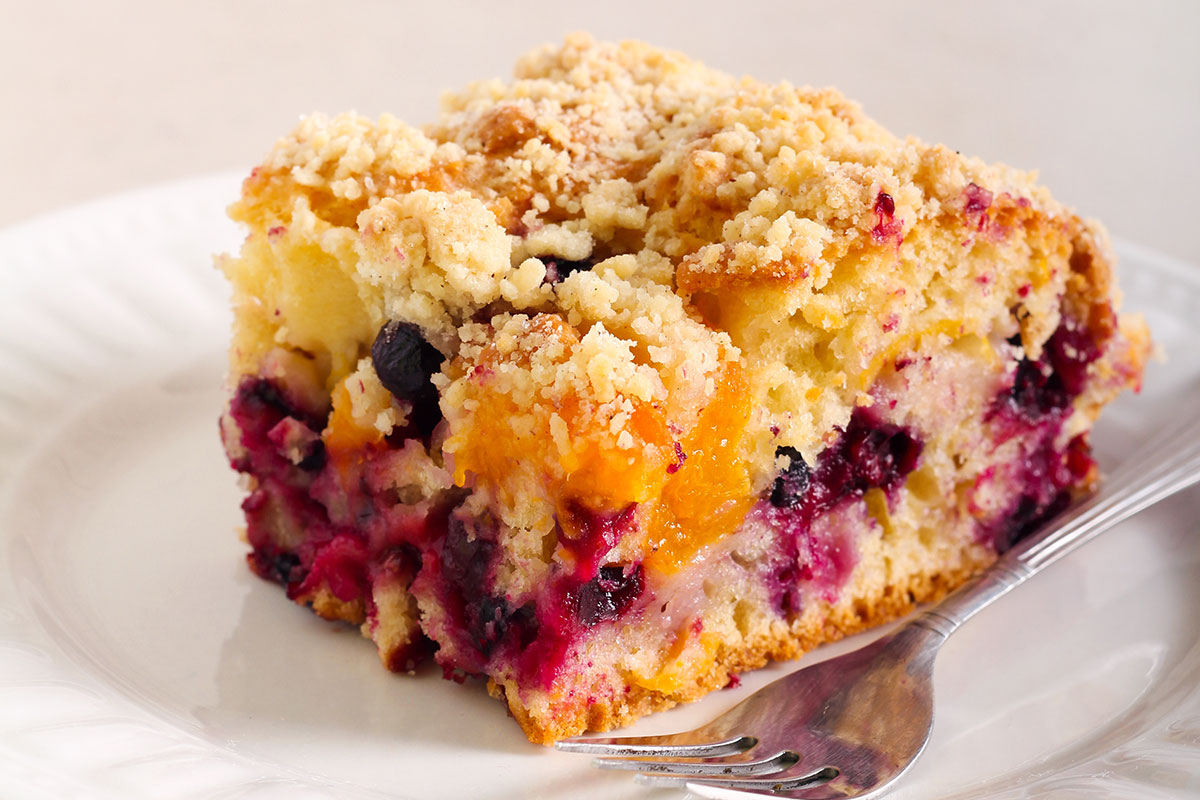
This recipe is sized to feed a crowd—any leftovers make a terrific breakfast the next day. Choose fruit based on availability—it’s as delicious with just one variety as it is with four or more! Right out of the oven, the buckle is exceptional when topped with olive oil ice cream, a simple frozen treat you can make at home.
Ingredients
For the crumble topping:
4 ounces unsalted butter, cubed and chilled
1 cup sugar
2/3 cup all-purpose flour
1/2 teaspoon ground cinnamon
For the cake:
1/2 cup extra virgin olive oil, plus more for the baking dish
8 ounces unsalted butter at room temperature
2 cups sugar
8 large eggs
3 cups all-purpose flour
1 teaspoon fine salt
1-1/2 teaspoons baking powder
6 cups assorted berries and stone fruit chunks (skin on)
Optional toppings: fresh blueberries, confectioners’ sugar for dusting, lightly whipped cream, or ice cream
Directions
Step 1
Preheat your oven to 350°F. Lightly coat a 13-inch by 9-inch baking dish with olive oil; set aside.
Step 2
Make the topping: Use your hands or a pastry blender to turn the butter, sugar, flour, and cinnamon into small bits, ranging from the size of peas to the size of beans. Set aside.
Step 3
Make the batter: In a large bowl, cream butter and sugar with an electric mixer until fluffy. With the machine running on low, slowly pour in the olive oil and then add the eggs, one at a time, beating after each addition until combined. In a separate bowl, whisk together flour, salt, and baking powder. With your mixer on a low speed, gradually add flour mixture to the wet batter until incorporated.
Step 4
Transfer the batter to the baking dish and use a large offset spatula to smooth the surface. Arrange the fruit in a fun pattern over the top and then sprinkle on the crumble, being careful to get it into the corners of the dish so that every bite includes it.
Step 5
Bake until the top of the cake is browns lightly and the tip of a sharp knife inserted in the center comes out clean, about an hour. Serve while still warm.
Pasta e Fagioli Salad Recipe, Spotlight on Tomatoes, How to Quick Soak Beans and Guard Against Forever Chemicals (PFAS), Plus Exercise and Inflammation
Looking for a satisfying dish that requires a minimum of cooking? You’ll love this adaptation of the classic pasta e fagioli soup, a unique way to savor ripe tomatoes (turning large tomatoes into chunks will work as well as the cherry tomatoes). Canned beans offer convenience, but you can try my quick hack for soaking dried beans if you’d like to make your own. You’ll also find strategies to limit exposure to dangerous PFAS (dubbed “forever chemicals”) and insights into how exercise delivers health benefits.
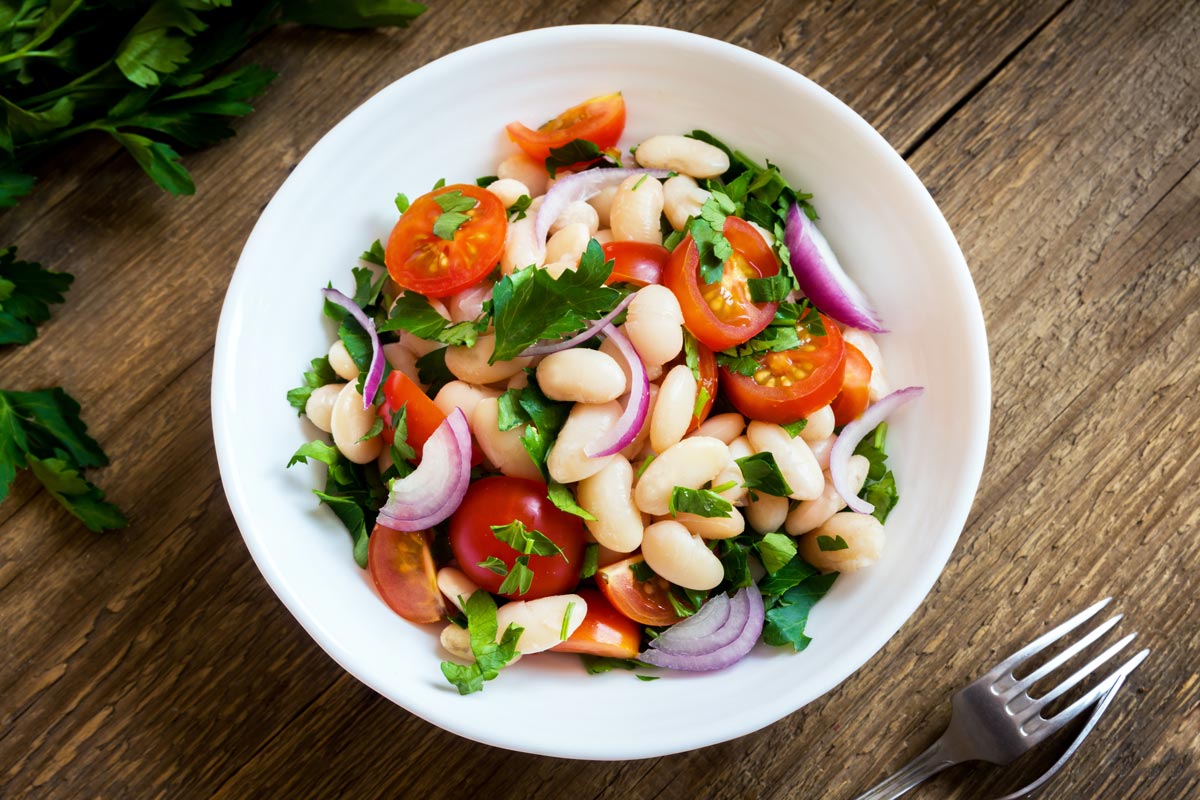
You know pasta e fagioli as a hearty soup that stars the tiny pasta tubes called ditalini and creamy white beans, perfect for chilly nights. But there’s no reason to “table” this great combination when you can give it a summery twist: a salad composed of all its delicious ingredients, plus a sweet-tart vinaigrette great for all kinds of salads. If you can’t find ditalini, you can use any small-sized pasta—the idea is to get a variety close to the size of the beans. For another layer of flavor, top with shavings of Parmigiano-Reggiano cheese.
Ingredients
2 tablespoons red wine vinegar
2 tablespoons balsamic vinegar of Modena
1 tablespoon Dijon mustard
1 tablespoon honey
1/2 teaspoon coarse salt, plus more to taste
1/2 garlic clove, minced
1/2 cup extra virgin olive oil
Freshly ground black pepper to taste
3 cups cooked cannellini beans or one 29-ounce can, rinsed and drained
3 cups cooked pasta, such as ditalini
3 cups cherry tomatoes
1 medium red onion, slivered
2 tablespoons each chopped fresh parsley and basil, plus more for garnish
Directions
Step 1
Make the vinaigrette: In a medium bowl, whisk together the two vinegars, mustard, honey, salt, and garlic. Gradually whisk in the olive oil until the dressing is emulsified. Season to taste with salt and pepper. Set aside.
Step 2
Place the beans, pasta, tomatoes, red onion, and herbs in a large glass bowl and pour on the vinaigrette. Toss gently to coat. Serve at room temperature or chilled, garnished with more herbs.
Yields 6 generous servings
Healthy Ingredient Spotlight
Tomatoes, Tomatoes, Tomatoes
There’s no better time to enjoy tomatoes than summer. For the sweetest cherry tomatoes, look for Sungolds and other bright-yellow varieties—wonderful in the pasta e fagioli salad. I love to stuff huge beefsteak tomatoes with tuna flakes from a just-grilled filet and then drizzle them with a vinaigrette. Don’t forget to sample heirloom tomatoes in fanciful colors and shapes.
When shopping your local farmers’ markets, look for tomatoes with smooth, mostly unblemished skin, but remember that organic tomatoes may not look picture-perfect, and that’s OK. More important is that the tomatoes feel ripe all around—firm, but not hard, and definitely not squishy. Then give them the sniff test—they should smell like…tomatoes!
Quick Kitchen Nugget
A Fast Way to Soak Dried Beans
One reason to buy dried beans rather than canned is the greater variety available, plus you control the salt. But, of course, that involves remembering to first soak the beans and then cooking them until tender. Here’s a hack to speed up the process—it’s especially handy if you forget to soak the beans the night before you want to use them.
Step 1: “Hot soak” the dried beans. In a large pot, add 1 pound of dried beans and 6 cups of cold water (multiply as needed). Bring to a boil, and boil for 3 minutes. Remove the pot from the heat, cover, and let soak for 1 hour.
Step 2: Cook the soaked beans. Drain and rinse the beans in cool water, and wash out the pot. Return the beans to the cleaned pot and cover them with cold water. Bring to a boil, turn the heat down to a simmer, cover, and cook until tender, but not mushy, about 1 hour for cannellini beans (larger beans may take up to an hour more).
For Your Best Health
Guarding Against “Forever Chemicals”
News of chemical manufacturer 3M agreeing to pay over $10 billion to settle lawsuits over contamination of many US public drinking water systems by its harmful compounds has brought national attention to the problem of per- and polyfluoroalkyl substances or PFAS. They’re called forever chemicals because they don’t degrade naturally in the environment. And they’re dangerous—exposure over time has been linked to health problems, including liver and immune-system damage, heart disease, some cancers, irritable bowel syndrome (IBS), and decreased fertility, according to experts at Hartford Healthcare.
Here’s advice from the watchdog group NRDC you can use to protect yourself:
Replace nonstick pans with stainless steel, cast-iron, glass, or ceramic alternatives.
Consider transferring store-bought foods to glass containers when you get home. Don’t heat food wrapped in grease-resistant packaging or reheat leftovers in takeout containers. Make popcorn on the stovetop instead of in PFAS-treated microwave bags. Look for BPI-certified compostable packaging, which doesn’t contain PFAS.
Choose clothing brands that have removed PFAS from their lines, such as American Eagle and L.L.Bean.
Avoid buying any home furnishings labeled water- or stain-repellent, which likely involve treatments that use PFAS.
Install reverse osmosis filters on your water faucets to get PFAS out of your drinking water.
Fitness Flash
How Exercise Helps with Inflammation
Researchers have long known that moderate exercise has a beneficial impact on the body’s response to inflammation, but what’s been less understood is why. New research done on a mouse model at York University in Toronto, Canada, suggests that the answers may lie within the body’s macrophages, white blood cells responsible for killing off infections, healing injury, and otherwise acting as your internal first responders.
“Much like you train your muscles through exercise, we showed that exercise of moderate intensity ended up training the precursors of those macrophages in the bone marrow,” says Ali Abdul-Sater, PhD, associate professor in the University’s School of Kinesiology and Health Science and York Research Chair. “The way that exercise is doing this is by changing the way those cells breathe—essentially, how they use oxygen to generate energy and then changing the way they access their DNA.”
While many studies have looked at temporary boosts to the immune system immediately after exercise, this study, published in the American Journal of Physiology-Cell Physiology, found these changes occurred even a week later, suggesting that they are long term.
“Inflammation is amazing—it’s a very important part of our normal immune response,” says Dr. Abdul-Sater. Inflammation is the body’s response to infection and other stressors, and some level of inflammation is necessary and desirable. “What we’re concerned about is excessive inflammation,” he explains. “Heart disease, diabetes, many cancers, and autoimmune diseases all essentially begin because there was an inappropriate inflammatory response.”
The study found that, for active mice, it was around the six-to-eight-week mark into the exercise regimen when changes really became apparent. “There’s a lot of rewiring that’s taking place in the circuitry of how the cells breathe, how the cells metabolize glucose, how the cells then access DNA. So all that just takes time.”
Dr. Abdul-Sater says that because the inflammatory response is a very ancient one, this aspect of the immune system is generally very similar across mammals, and he expects the research will translate well to people. In the next phase, the team will collect immune cells from human volunteers who will do exercises of various intensities to see which workout routines are most beneficial to balance the inflammatory response.
“The thing with humans is there’s no intervention that will work on everyone. We know that, but what this study suggests is that moderate and persistent exercise not only improves metabolic health, but also will improve immune health in the long run.”
You know pasta e fagioli as a hearty soup that stars the tiny pasta tubes called ditalini and creamy white beans, perfect for chilly nights. But there’s no reason to “table” this great combination when you can give it a summery twist: a salad composed of all its delicious ingredients, plus a sweet-tart vinaigrette great for all kinds of salads. If you can’t find ditalini, you can use any small-sized pasta—the idea is to get a variety close to the size of the beans. For another layer of flavor, top with shavings of Parmigiano-Reggiano cheese.
Ingredients
2 tablespoons red wine vinegar
2 tablespoons balsamic vinegar of Modena
1 tablespoon Dijon mustard
1 tablespoon honey
1/2 teaspoon coarse salt, plus more to taste
1/2 garlic clove, minced
1/2 cup extra virgin olive oil
Freshly ground black pepper to taste
3 cups cooked cannellini beans or one 29-ounce can, rinsed and drained
3 cups cooked pasta, such as ditalini
3 cups cherry tomatoes
1 medium red onion, slivered
2 tablespoons each chopped fresh parsley and basil, plus more for garnish
Directions
Step 1
Make the vinaigrette: In a medium bowl, whisk together the two vinegars, mustard, honey, salt, and garlic. Gradually whisk in the olive oil until the dressing is emulsified. Season to taste with salt and pepper. Set aside.
Step 2
Place the beans, pasta, tomatoes, red onion, and herbs in a large glass bowl and pour on the vinaigrette. Toss gently to coat. Serve at room temperature or chilled, garnished with more herbs.
Roasted Ratatouille Recipe, For Your Best Heart Health: The Mediterranean Diet Fights Heart Attacks and Stroke
There’s no shortage of “best diet” lists for losing weight, but they don’t always have scientific backing or address the bigger picture that includes taking care of your overall health.
When I share the benefits of olive oil, it’s often in the context of the Mediterranean diet. After all, no matter how delicious the freshest extra virgin olive oil is, you need other foods to enjoy it fully! The Mediterranean diet has scores of studies that support its adoption.
Now a new research review goes a step further: the authors did a deep dive to compare it to six other diets that claim to lower heart attacks and death rates in people with heart disease. These included the Pritikin diet, the Ornish diet, and a very, very low-fat diet, all known to be extremely restrictive. The Mediterranean diet bested them all, with the bonus benefit of stroke prevention (details below), plus it tastes great.
A case in point is the following recipe. For those who only know “Ratatouille” as the lead character from the Disney classic, let me introduce you to the dish that inspired his name…with my own personal twist, of course!
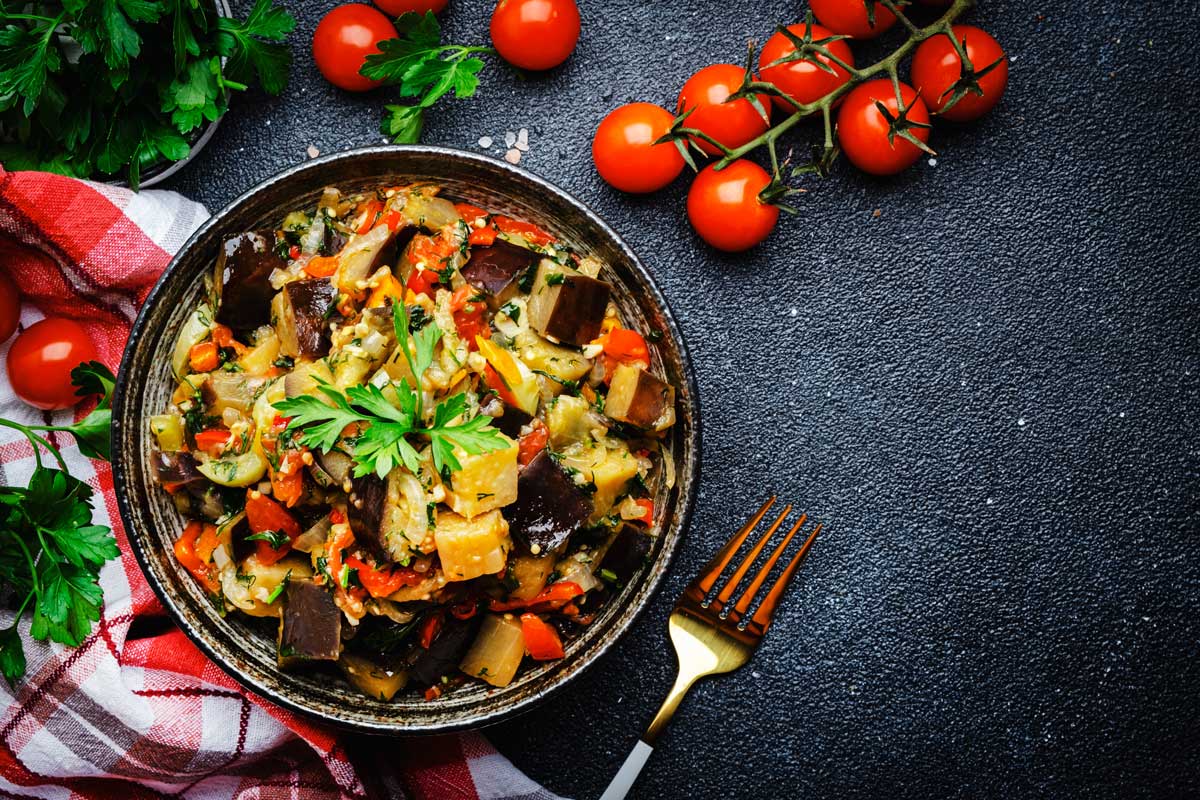
All the flavors of seasonal bounty meld together in this dish. Rather than cooking it on the stovetop, it’s roasted in the oven, with minimal attention. This technique helps preserve the taste and texture of the individual vegetables, even as they cook in each other’s juices, and creates more of a caramelized medley than a stew. Ratatouille makes a delicious side dish, a topping for grilled bread or pasta, and a hearty sauce for roasted chicken or fish.
Ingredients
1 small eggplant, about 1 pound
1-1/2 pounds tomatoes, any variety
1 pound zucchini or summer squash, green and/or yellow
3 yellow, orange, or red bell peppers
1 large onion, about 1 pound
8 cloves garlic, sliced
7 tablespoons extra virgin olive oil, divided, plus more for the pans
2 teaspoons coarse sea salt
Freshly ground black pepper, to taste
1 tablespoon balsamic vinegar from Modena, plus more to taste
1 tablespoon chopped fresh flat-leaf parsley
Directions
Step 1
Preheat your oven to 350°F. Cut all the vegetables into roughly 1-inch diced pieces and mix together along with the garlic in a large bowl. Add 6 tablespoons of olive oil and the salt, and toss to coat. Lightly oil two rimmed sheet pans (or line them with parchment paper) and divide the vegetables between them. Roast the veggies for a total of 3 hours.
Step 2
After the first hour, as the vegetables give up their moisture and shrink in volume, combine them in one of the sheet pans; after the second hour, flip the veggies with a large spatula.
Step 3
When done, transfer the vegetables back to the large bowl, taking care to get all the juices. Season with pepper, drizzle on the last tablespoon of olive oil and the vinegar, and sprinkle with the parsley.
Serves 8
For Your Best Heart Health
The Mediterranean diet fights heart attacks and stroke
The study: “Comparison of seven popular structured dietary programmes and risk of mortality and major cardiovascular events in patients at increased cardiovascular risk: systematic review and network meta-analysis,” BMJ, March 2023.
The analysis: In the first study of its kind, an international group of researchers from the US, Canada, Brazil, Colombia, Spain, and China analyzed the effects of seven different popular diet plans designed to reduce “the likelihood of death and heart attack in people at heightened risk of cardiovascular disease.” They compared the plans to each other and to “minimal intervention efforts” such as being handed a brochure on healthy diets.
After searching through research databases, they identified 40 eligible trials involving a total of 35,548 participants who had heart disease—or at least two known risk factors for it—and who were followed for an average of three years on these popular diets: low fat (18 trials), Mediterranean (12 trials), very low fat (six trials), modified fat (four trials), combined low fat and low sodium (three trials), Ornish (three trials), and Pritikin (one trial). Some trials compared two different diets to each other.
The researchers pointed out that, although many of these diets have the aura of heart health and are often recommended to people at risk of heart problems, such recommendations have relied on “low certainty evidence from non-randomized studies.” Translation: there’s a lack of gold-standard studies supporting their benefits.
The researchers found that of the seven programs, based on “moderate certainty evidence,” Mediterranean dietary programs were better than minimal intervention at preventing all-cause mortality (17 fewer deaths per 1,000 over five years), nonfatal heart attack (17 fewer deaths per 1,000), and stroke (seven fewer deaths per 1,000) for patients at intermediate risk of cardiovascular disease. Low-fat programs were superior to minimal intervention, with moderate certainty for prevention of all-cause mortality (nine fewer deaths per 1,000) and nonfatal heart attack (seven fewer deaths per 1,000) but did not impact stroke risk.
“The absolute effects for both dietary programmes were more pronounced for patients at high risk of cardiovascular disease (36 fewer all-cause deaths per 1,000 and 39 fewer cardiovascular deaths per 1,000 among those that followed the Mediterranean dietary programme over 5 years),” the review concluded. “The five remaining dietary programmes generally had little or no benefit compared with minimal intervention typically based on low to moderate certainty evidence.”