
Double Strawberry Mousse Recipe, Spotlight on Strawberries, Buying and Storing Strawberries, The Impact of Carbs and Lowering Your Disease Risk
As farmers’ markets pop up around the country, look for fresh strawberries ripe for turning into luscious desserts. This mousse is sinfully rich, yet so easy to whip up. Whole foods are crucial to a healthy diet, and the first study I’m sharing shows what happens when we eat too many refined carbs. The second sheds new light on the importance of exercise intensity.
Double Strawberry Mousse
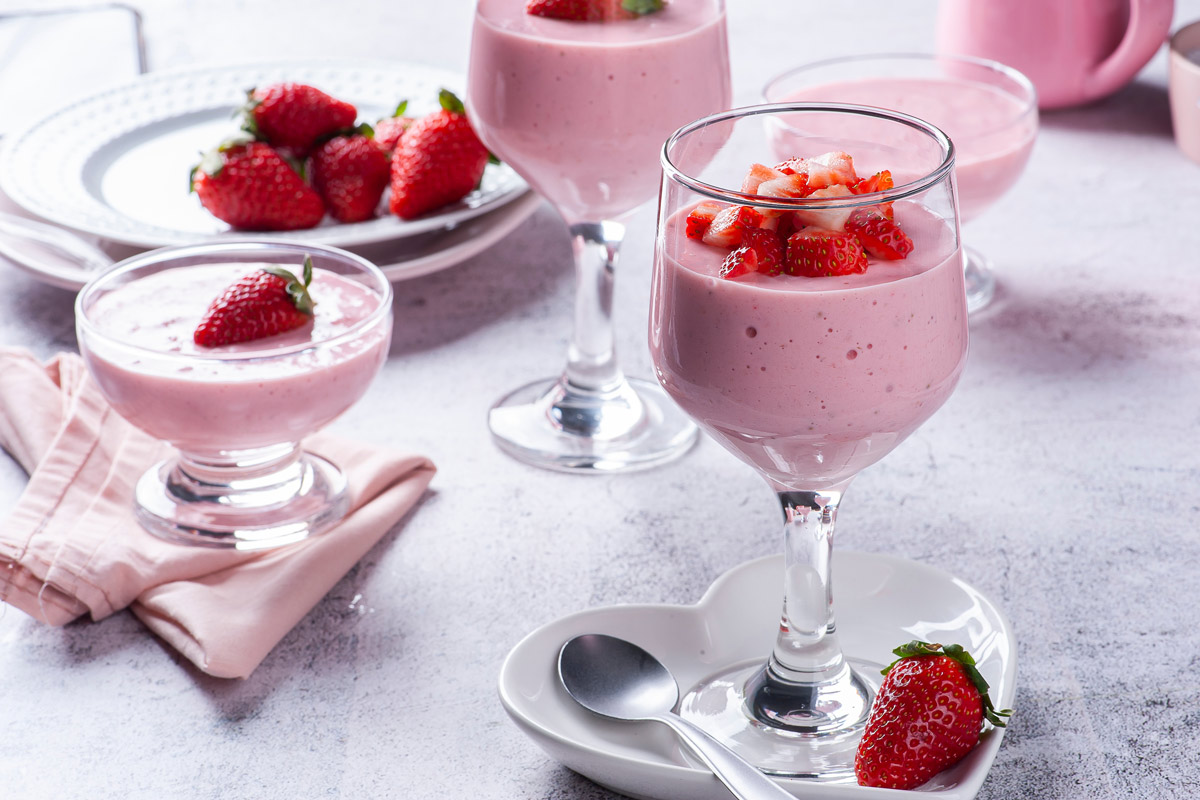 Double Strawberry Mousse
This dessert features strawberries in the mousse and in the topping. The berries are first macerated — tossed with sugar and allowed to sit — to draw out and intensify the fruit’s flavors.
Ingredients
- 1 1/2 pounds fresh strawberries
- 2 tablespoons granulated sugar
- 1 tablespoon extra virgin olive oil
- 1 1/2 cups heavy cream
- Optional: 1/3 cup confectioners’ sugar
Directions
Step 1
Hull the strawberries, then dice them and place in a large glass bowl. Add the granulated sugar and toss well; set aside for 30 minutes. Drizzle on the olive oil and mix well. Reserve 1/2 cup of the berries, cover, and refrigerate. Place the rest in a food processor and run the machine until the berries are puréed. You should have about 1-1/2 cups.
Step 2
Place the heavy cream in the bowl of a stand mixer or a large bowl with a hand mixer. Beat on low speed, then gradually increase to high. Whip until the cream reaches medium (not stiff) peaks, then use a spatula to fold in the strawberry purée. Taste and add the confectioners’ sugar if desired. Serve right away or refrigerate the mousse in the mixing bowl for up to 4 hours — it will firm up more as it chills.
Step 3
To serve, spoon equal portions of the mousse into 8 goblets or bowls and garnish with equal amounts of the reserved berries.
Serves 8

Healthy Ingredient Spotlight
Strawberries
Strawberries are packed with essential vitamins, minerals, fiber, and phytochemicals, including anthocyanins, which give them their vivid hue, and other antioxidants to protect against oxidative stress. A study published in the journal Nutrition, Metabolism and Cardiovascular Diseases found that eating about 2 cups of strawberries a day improves heart health and cognition in older adults.
There is one caveat. According to the Environmental Working Group, strawberries have high levels of pesticides including “forever chemicals” (PFAS) and fungicides—they’re often ranked at the top of the Group’s “Dirty Dozen” list of most affected fruits and vegetables. Because of this, buy organic whenever you can to reduce your exposure to substances linked to cancer, hormone disruption, and brain toxicity.


Quick Kitchen Nugget
Buying and Storing Strawberries
Look for bright red strawberries, with bright green caps, and free of moldy spots. If you’re buying berries packed in plastic boxes, be sure to turn them over and check the underside. At home, refrigerate your berries if not using right away, but don’t wash them ahead of time, which could increase the risk for mold. Store packaged berries upside down — this puts the ventilation slots on top, allowing better air circulation.

For Your Best Health
The Impact of Carbs
Bread has long been a dietary cornerstone, sustaining societies for generations. It is deeply woven into everyday life. Carbohydrates such as bread, rice, and noodles are consumed daily around the world, yet their role in obesity and metabolism has not been explored thoroughly. With obesity rates continuing to climb, researchers are beginning to question whether this reliance on staple carbohydrates still makes sense in modern diets. While many people believe that “bread makes you gain weight” or that “carbohydrates should be limited,” it has been unclear whether the issue lies in the foods themselves or in how people choose and consume them.
To better understand these questions, a research team led by Professor Shigenobu Matsumura at Osaka’s Graduate School of Human Life and Ecology in Japan studied how carbohydrates influence eating behavior and metabolism in mice. The researchers examined whether mice preferred foods like wheat, bread, and rice over standard chow, and how these choices affected body weight and energy use. The animals were divided into several feeding groups, including Chow, Chow + Bread, Chow + Wheat flour, Chow + Rice flour, High-fat diet (HFD) + Chow, and HFD + Wheat flour. The team tracked changes in body weight, energy expenditure, blood metabolites, and liver gene expression.
The findings showed that mice strongly favored carbohydrate-rich foods and stopped eating their standard chow altogether. Even though their total calorie intake did not increase significantly, both body weight and fat mass went up. Mice that consumed rice flour gained weight in a similar way to those that ate wheat flour. In contrast, mice given a High-fat diet (HFD) + Wheat flour gained less weight than those on a High-fat diet (HFD) + Chow. “These findings suggest that weight gain may not be due to wheat-specific effects, but rather to a strong preference for carbohydrates and the associated metabolic changes,” said Professor Matsumura.
Further analysis revealed higher levels of fatty acids in the blood and lower levels of essential amino acids. In the liver, fat accumulation increased, along with the activity of genes linked to fatty acid production and lipid transport. When wheat flour was removed from the diet, both body weight and metabolic abnormalities improved quickly. This suggests that moving away from a wheat-heavy diet and toward a more balanced one may help regulate body weight more effectively.
“Going forward, we plan to shift our research focus to humans to verify the extent to which the metabolic changes identified in this study apply to actual dietary habits,” said Professor Matsumura. “We also intend to investigate how factors such as whole grains, unrefined grains, and foods rich in dietary fiber, as well as their combinations with proteins and fats, food processing methods, and timing of consumption, affect metabolic responses to carbohydrate intake. In the future, we hope this will serve as a scientific foundation for achieving a balance between ‘taste’ and ‘health’ in the fields of nutritional guidance, food education, and food development.”

Fitness Flash
Lowering Your Disease Risk
Just a few minutes of getting out of breath each day could significantly cut your risk of major diseases including heart disease, dementia, and diabetes. A large study of nearly 100,000 people published in the European Heart Journal found that it’s not just how much you move, but how intensely you move that matters. Short bursts of vigorous activity—like rushing for a bus or climbing stairs quickly—were linked to striking reductions in disease risk, especially for inflammatory conditions like arthritis, serious cardiovascular problems such as heart attack and stroke, and dementia.
To explore this connection, researchers compared participants’ overall physical activity levels with how much of that activity was vigorous, then tracked their risk of developing eight major diseases over time. The study was led by an international team that included Professor Minxue Shen from the Xiangya School of Public Health at Central South University in Hunan, China. “We know that physical activity reduces the risk of chronic disease and premature death, and there is growing evidence that vigorous activity provides greater health benefits per minute than moderate activity,” he said. “But questions remain about the importance of intense activity versus total physical activity. For example, if two people do the same total amount of activity, does the person who exercises more vigorously gain greater health benefits? And if someone has limited time, should they focus on exercising harder rather than longer?”
Participants, all part of the UK Biobank study, wore wrist-based accelerometers for one week. These devices captured detailed movement patterns, including short bursts of vigorous activity that people might not remember or report. Researchers used this data to calculate both total activity and the share that was intense enough to cause breathlessness.
The team then compared these measurements with participants’ likelihood of dying or developing eight serious conditions over the next seven years: major cardiovascular disease, irregular heartbeat, type 2 diabetes, immune-mediated inflammatory diseases, liver disease, chronic respiratory diseases, chronic kidney disease, and dementia.
The results showed that people who devoted a larger portion of their activity to vigorous movement had much lower risks across all conditions studied. Compared with those who did no vigorous activity, individuals with the highest levels saw a 63% lower risk of dementia, a 60% lower risk of type 2 diabetes, and a 46% lower risk of death. These benefits were observed even when the total time spent on vigorous activity was relatively small.

The researchers also found that intensity played a larger role for certain diseases. For inflammatory conditions such as arthritis and psoriasis, intensity appeared to be the key factor in lowering risk. In contrast, for diseases like diabetes and chronic liver disease, both how long people were active and how hard they exercised were important.
“Vigorous physical activity appears to trigger specific responses in the body that lower-intensity activity cannot fully replicate,” Professor Shen said. “During vigorous physical activity — the kind that makes you feel out of breath — your body responds in powerful ways. Your heart pumps more efficiently, your blood vessels become more flexible, and your body improves its ability to use oxygen. Vigorous activity also appears to reduce inflammation. This may help explain why we saw strong associations with inflammatory conditions such as psoriasis and arthritis. It may also stimulate chemicals in the brain that help keep brain cells healthy, which could help explain the lower risk of dementia.
“Our findings suggest that making some of your physical activity vigorous can provide substantial health benefits. This doesn’t require going to the gym. Adding short bursts of activity that make you slightly breathless into daily life, like taking the stairs quickly, walking fast between errands, or playing actively with children, can make a real difference. Even 15 to 20 minutes per week of this kind of effort — just a few minutes a day — was linked to meaningful health benefits.
“Current guidelines generally focus on the amount of time spent being active per week. Our findings suggest that the composition of that activity matters and matters differently depending on which diseases you’re trying to prevent. This could open the door to more personalized physical activity recommendations based on an individual’s specific health risks,” he said, adding, “Vigorous activity may not be safe for everyone, especially older adults or people with certain medical conditions. For them, any increase in movement is still beneficial, and activity should be tailored to the individual.”
Get More Recipes In Your Inbox!