

From the Heart of Il Bel Paese Three Beautiful Extra Virgin Olive Oils To Create Magical Meals with Friends and Family
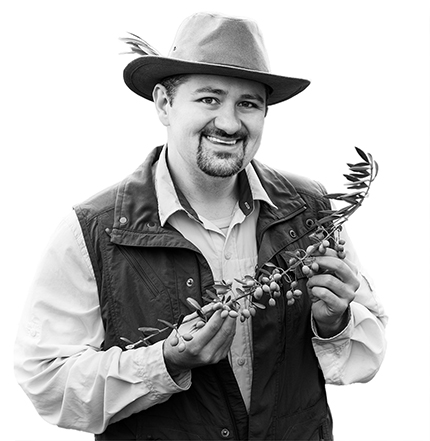
- Enjoy this dazzling trio, hand-selected by your Olive Oil Hunter, with prized varietals from award-winning family farms.
- Savor vibrant flavors that reflect bountiful polyphenols, the nutrients responsible for extra virgin olive oil’s many health benefits.
- Know that they’re certified 100 percent extra virgin olive oil by an independent lab and were rushed to the US by jet for maximum freshness and flavor.
For millennia, olives have played a part in every aspect of Italian culture, from food to religious observances to medicine. With over 500 olive varieties, the harvest is an especially magical time here. The tourist crowds are mostly gone, the weather is cooler, and the air is perfumed with the green, herbaceous aroma of olio nuovo. But the relaxed pace that a casual visitor might enjoy is a world apart from the intensity with which my Merry Band of Tasters and I move as we hunt for the ultimate extra virgin olive oils for our Club members.

“Go South, Young Man”
We had an inkling of what to expect before we landed in Rome, with advance word that it would be a difficult season for many producers in Central Italy—Tuscany, Umbria, Lazio—because of the vagaries of Mother Nature.
This was apparent at the grand tasting organized by international olive oil virtuoso Duccio Morozzo della Rocca, yet we were dazzled by the first batch of samples from other regions. We narrowed it down to our leading contenders and headed east to Abruzzo, then south to Puglia (with a fun side trip to Campania), to create the sensational trio.

A Brush with History
In Penne, a town known for its historic brick structures (and the fashion house of Brioni), we worked with Claudio Di Mercurio of Frantoio Mercurius to craft an exquisite Dritta, our medium oil. Dritta means reliable—but never staid—and it lived up to its name once again. We deliciously enhanced it with Leccino and Frantoio. I was equally thrilled when Claudio organized a dinner with Dr. Marino Giorgetti, a groundbreaking figure in the world of extra virgin olive oil.
Dr. Giorgetti’s career started in the early ’80s at the Experimental Institute for Elaiotechnics (the science and technology of olive oil production) in Città Sant’Angelo. He was soon collaborating with Dr. Mario Solinas, the pioneering agronomist who conceptualized the sensory analysis of olive oil. Earlier olive oil assessment had been based purely on chemistry. The organoleptic descriptors used today—including those in our own “Impressions” sections—did not exist. An olive oil could get a pass on paper but completely fail on taste. There weren’t even words to express taste defects that characterize inferior oils. That all changed in 1989, when the International Olive Council adopted the use of sensory analysis, based on the work of Dr. Solinas and his counterparts in five other countries, forever redefining how extra virgin olive oil would be judged.
Since then, Dr. Giorgetti has traveled the world, teaching olive oil professionals how to be panel tasters—the top judges at competitions—using sensory descriptors. For more than 20 years, he has been panel leader and technical director of the Sol d’Oro International Competition, an organization with the foresight to hold separate events for the Northern and Southern hemispheres so that neither is at a freshness disadvantage, given their opposite harvest seasons. This desire to optimize freshness is the same reason that I, each year, divide my olive oil quests between the globe’s halves.

The Adriatic Awaits
Our hunt continued in Puglia, where we worked with brothers Nicola and Mario of Fratelli Ruggiero to craft our mild oil, an amazing Favolosa with a touch of Don Carlo. These two olives are modern-era cultivars, celebrated for their divine fruitiness and spiciness—mild, yes, but brimming with amazing aromas and fabulous flavors.
Having reconnected last year with master miller Nicolangelo Marsicani (we originally met over a decade ago!), I was eager to collaborate with him on our exceptional bold selection. I call him the Picasso of olive oil because of his ingenious artistry that went into creating our vibrant and perfectly balanced Coratina.
Puglia also tempted me with its many culinary treasures, from the freshest seafood in coastal Bari to the heartier dishes in storied inland towns like Altamura and Mariotto. I’m thrilled to share some of these delights with you in the recipe section. As always, they—and your own favorite recipes—will be elevated by the delicious oils in this trio.
Happy drizzling!

T. J. Robinson
The Olive Oil Hunter®
This Quarter’s First Selection
- Producer: Fratelli Ruggiero, Puglia, Italy 2025
- Olive Varieties: Favolosa, Don Carlo
- Flavor Profile: Mild

After the success of our inaugural Fratelli Ruggiero olive oil last year, I couldn’t wait to reconnect with Nicola and Mario Ruggiero, the fratelli (brothers) creating exquisite liquid gold in Puglia.
From our very first meeting, I felt that Nicola and I were kindred spirits. Just over 20 years ago, while I was starting this Club to bring unmatched fresh-pressed oils to the US, Nicola sensed a growing desire in his country for artisanal EVOO—food-friendly oils with distinctive flavor profiles to lavish on favorite dishes. That was when he decided to add Favolosa to his groves for its herbaceous personality, “with more perfume of green grass,” as he described. Another cultivar, Don Carlo, with notes of Mediterranean herbs, soon followed.
Fast forward to this year’s harvest. Don Carlo was so enchanting when we tasted it at the mill that I decided to create another exciting first for the Club: the combination of Favolosa enhanced with Don Carlo. While most beloved olive cultivars are thousands of years old, these two are making history after mere decades. Both were developed naturally in the late 1980s–early 1990s by the late Giuseppe Fontanazza, director of the Institute of Research on Olive Growing of Perugia and a legend in the field of olive culture. He saw the need for olives that would thrive in the face of growing environmental challenges such as drought and disease while, of course, producing stunning oils.

The Favolosa and Don Carlo trees are indeed thriving in the Ruggiero groves, thanks in part to genetics but also to key steps Nicola and Mario have taken. Because of less rain each year, they switched to a more targeted irrigation system that uses water more efficiently. They also insist on top-of-the-line milling equipment. When other producers doubted such big investments, Nicola waved them off, knowing that these decisions would all be reflected in the bottle.
As happened to many other producers this year, a good number of blossoms in the Ruggiero groves were lost to frost. In this situation, a tree, despite bearing less fruit, will still provide the same amount of energy for the fruit’s development, causing the existing olives to ripen faster than normal—making it easy to miss the magic window, the perfect time to harvest for optimal flavor. But the Ruggiero team knows when and how to harvest. On hand this season was Dr. Andrea Pezzolla, an agronomist born and raised in Puglia and a highly sought-after miller. Talk about a small world—he spends a month in the Southern Hemisphere during its harvest and often works with our Australia-based friend and producer Leandro Ravetti. We so appreciated Andrea’s input as we perfected the final blend.
My Merry Band of Tasters and I were able to explore more of Puglia on this trip, especially the food! One bite and we knew why Puglia is called the breadbasket of Italy—its locally grown durum wheat gives bread and pasta unique flavor. I’ve translated the most delectable dishes into recipes that you can enjoy, each elevated by this marvelous olive oil.

Impressions and Recommended Food Pairings
This exquisite expression of the Favolosa and Don Carlo olive varieties is both vibrant and rare. Inhale the freshness of green grass and tomato leaf along with baby spinach, Belgium endive, arugula, celery, parsley, basil, green banana, apple, and vanilla. On the palate, it’s bright and persistent, evoking fresh walnut, tomato, and celery leaf, with the lingering bitterness and spiciness of arugula and white pepper and pleasing notes of sweet almond on the finish.
It’s perfect for mild vinaigrettes to drizzle on salads and other greens. It will elevate smoothies, yogurt, eggs, mozzarella, fresh tomatoes, and avocado. It will enhance chicken scarpariello,* turkey, mild fish, and shrimp dishes; pasta sauces; Tuscan braised green beans; root vegetable soups; grains and legumes, especially white beans and lentils; and lingue di gatto and other cookies.
*See the recipe section below for bolded dishes.
This Quarter’s Second Selection
- Producer: Frantoio Mercurius, Abruzzo, Italy 2025
- Olive Varieties: Dritta, Leccino, Frantoio
- Flavor Profile: Medium

An invaluable tip from olive oil expert Duccio Morozzo della Rocca, a charter member of my Merry Band of Tasters, motivated me in 2018 to check out Claudio Di Mercurio’s farm in Abruzzo. Claudio, Duccio said, was milling exquisite olive oil on his 60-acre farm. Though a novice (Claudio produced his first oil in 2010), his oils were already winning awards. We even had a mutual friend—Giorgio Mori—a manufacturer of high-end olive milling equipment, who helped Claudio outfit his state-of-the-art olive mill.
Though I’d made many trips to Italy, I’d never visited Abruzzo until then. This stunning region, pinned between the Apennine Mountains and the Adriatic Sea, is known as the greenest region in Italy. (Incredibly, 70 percent of the European continent’s species of wildlife call Abruzzo home.) When we first met, the genial Claudio introduced me to an Abruzzese cultivar—Dritta (rhymes with Rita). I was positively captivated. I couldn’t wait to share this remarkable oil with my Club members. Unbelievably, this is the eighth consecutive year this vigorous, highly dependable olive has met my rigorous standards. Its record is unprecedented. Most olive cultivars alternate yearly between high and low production, allowing the trees to restore their energy.

This year, Claudio and his family welcomed my team and me to their hilltop home near Penne with their usual effusive warmth. It’s always great to affirm our strong bond by catching up in person with each other’s lives.
Claudio sprang a delightful surprise on me during my recent visit: He thoughtfully invited the esteemed olive oil expert Dr. Marino Giorgetti to join us for dinner one evening. I was thrilled to meet this olive oil pioneer. Read more about Dr. Giorgetti’s significant contributions to the development of standardized sensory criteria for olive oil above.
Once again, this was a great year for Claudio’s olives—he tends a healthy mix of Dritta and other Italian varietals. No surprise: Abruzzo’s isolation and unique microclimates have favored its olive trees for thousands of years. Its oils were praised by ancient Roman poets like Virgil and Ovid, who, if they could taste the current early harvest of “liquid gold” from Frantoio Mercurius, would faint with joy.
Also swoon-worthy are the magnificent meals Claudio’s sister Graziella prepares in a rustic stonework kitchen/pantry attached to the house. She pays homage to Abruzzo’s fabulous gastronomic heritage by cooking festive dishes like porchetta (slow-cooked spiced pork roll), stracciatella (a brothy soup with pasta), and my new favorite—tacchino alla Canzanese (boned and braised turkey, served with its natural gelatin). I felt supremely honored when Claudio confided that the family prepares these dishes for Easter, Christmas, and “when T. J. visits.”
I predict you will enjoy this extraordinary blend on a multitude of winter dishes. See my specific suggestions below.

Impressions and Recommended Food Pairings
Enhanced with Leccino and Frantoio, this Dritta delights. Take in the rich aromas of Tuscan kale and other dark leafy greens, artichoke, rhubarb, hazelnut, dark chocolate, apple, and culinary herbs like thyme, sage, and wild mint. These notes echo on the palate, along with the bitterness of radicchio, the sweetness of vanilla bean, and the spiciness of Szechwan peppercorns.
Drizzle it on salads with nuts and fruits, steamed artichokes, borlotti and other beans, even chocolate ice cream. It enriches frittatas, minestrone, pallotte cacio e uova* and other simmered tomato sauces; crown roast of lamb, pork, and game; salmon, tiella Barese, and other shellfish dishes; whole roasted carrots and other root vegetables; apple spice muffins and other baked treats, like banana and pumpkin quick breads.
*See the recipe section below for bolded dishes.
This Quarter’s Third Selection
- Producer: Nicolangelo Marsicani, Puglia, Italy 2025
- Olive Varieties: Coratina
- Flavor Profile: Bold

Earlier in this report, I refer to Nicolangelo Marsicani as the Picasso of olive oil, for his bold genius. I also think of him as a poet, heeding Emily Dickinson’s rule to “tell the truth, but tell it slant.” Sometimes he speaks in riddles, like the Sphinx.
Even the label on the extraordinary EVOO that bears his name is cryptic. When I ask him what the pentagon figure means, he pauses, then intones, “Perfect balance.” To me, the five-cornered shape looks like a constellation, reminding me that the stars must align when I select a superlative EVOO for my Club. Nicolangelo agrees, and we hone in on five critical factors that go into the production of a perfectly balanced olive oil: cultivar, climate/terroir, weather (Mother Nature), grove, and miller.
Let’s lead with the miller. Asked how he got his start, Nicolangelo quips, “Trapiantato,” “transplanted,” or, colloquially, “born this way.” I chuckle, but it’s accurate—the Marsicani family’s olive mill, in the town of Cilento, in Campania, was registered with the chamber of commerce in 1928. Over time, the farm passed to Nicolangelo. He dismisses his early work in the “traditional old style, with a dusty mill and not taking care of things.” Everything changed when he “discovered tasting,” in the early 2000s. (Read about the science of olive oil tasting in the Pressing Report intro.) “From night to day,” he says; he modernized the mill with state-of-the-art equipment to focus on crafting ultra-premium, high-polyphenol EVOO.
The Marsicani farm is an elite-level hub for quality-obsessed growers and millers across Italy—talented farmers bring their finest fruit to press, inspired millers come to collaborate, and the cross-pollination of expertise and experimentation forms lasting relationships and elevates the quality of Italian EVOO.

Reciprocally, Nicolangelo travels throughout the country, teaching (“learning,” he amends) and consulting at premier olive farms such as Fratelli Ruggiero, where we first collaborated last year. (We’d met more than a decade before, an encounter I recall with fond amusement, as it was clear that he was testing me. Fair enough—as an American in a safari hat, I’m accustomed to proving my bona fides.)
With the paucity of olives in central Italy this year, Nicolangelo and I convened in Puglia, along with Michele Siniscalchi, a gifted technician who works regularly with the master miller. Our sights were set on a field of gorgeous Coratina, a challenging cultivar that, when handled right, makes an exquisite oil: spicy, robust, mind-blowing. Anticipating the “magic window,” we had to wait a few days as the fruit came off the tree in stages; this enabled us to harvest successive batches of the same crop while the weather cooled a bit.
In the mill, Nicolangelo and Michele used “white gloves,” as the former puts it, modulating the crushing speed halfway through, slowing down the process to bring softer, rounder “edges” to the flavors. The different micro-batches combine to create a complex, dimensional, ultra-green-grassy-herbal-nutty, big, bold, fantastic oil.

Impressions and Recommended Food Pairings
This assertive Coratina is intense and complex on the nose, rich with the aromas of almond, artichoke, green grass, arugula, kiwi, fennel, oregano, rosemary, and black pepper. The intensity continues on the palate, with notes of green almond and wheatgrass; herbs like wild mint, oregano, and sage; the bitterness of chicory and green tea; and the persistent spiciness of black pepper, celery leaves, and watercress.
Lavish it on fried eggs; salads with kale and other dark greens; focaccia con patate,* crusty breads, and pizza; steak, veal, tuna, and sword-fish; curries and other Asian dishes. It will elevate creamy mushroom ragoût; winter veggies like broccoli and Brussels sprouts; hearty braises, bean soups, roasted potatoes, and roasted radicchio; aged cheeses; and double chocolate bundt cake and other dark chocolate desserts.
*See the recipe section below for bolded dishes.
Olive Oil and Health
One of the most powerful polyphenols in olive oil is hydroxytyrosol. Consuming hydroxytyrosol is linked to benefits in neurological, cardiovascular, and metabolic health, and the compound has demonstrated anti-inflammatory, anti-cancer, neuro-protective, and immuno-protective effects. A recently published scientific review in the journal Foods examines the growing body of evidence supporting the characterization of hydroxytyrosol as a “functional food,” with emphasis on its effects on neurological and cognitive processes.
What is it?
Hydroxytyrosol (hi-droxy-TY-roh-sol), abbreviated as HXT, is a phenol, a natural chemical that is both water-soluble and attracted to fats, which means that it can pass through cell membranes. Its chemical structure also explains its strong antioxidant and anti-inflammatory properties. HXT occurs mainly in olives—olive oil, fruit, leaves, and pulp—as well as in red and white wines.
What does HXT do in the brain?
HXT interacts with the brain and its vascular (blood vessel) system in 3 ways: 1) as an antioxidant and anti-inflammatory agent, HXT helps prevent damage to cerebral blood vessels and improves their function; 2) lab studies show that, by reducing oxidation and inflammation, HXT helps maintain the proper functioning of the blood-brain barrier (BBB), a crucial filter inside the brain’s blood vessels that controls what substances enter and exit the brain; 3) in studies in humans, consuming HXT in the form of high-phenolic EVOO resulted in less “leakage” across the BBB and, as reflected in participants’ performance on cognitive tests, improved connectivity between brain regions.
HXT and its metabolites (the components of a substance that are formed when metabolic processes, such as digestion, break it down) are able to cross the BBB to interact with specific brain processes, enhancing protective activity and dampening inflammatory activity that is linked to depression and cognitive decline.
How much HXT is needed to obtain its benefits?
In studies in humans, the above benefits were observed with an HXT intake ranging from 7 to 15 mg/day. In terms of EVOO, this translates to a daily consumption of about 25 to 50 ml of high-phenolic olive oil, or ~2 to 3 tablespoons. Table olives—regardless of their color or brining—also provide an excellent source of HXT.
What’s next for HXT?
This body of promising evidence has intensified interest in the development of HXT-enriched foods and other ways of delivering this health-promoting compound. HXT is highly bioavailable, which means that, after it is consumed and digested, it is readily absorbed and transported by the body. So, for now—perhaps for always—the most effective, efficient, and delicious way to obtain the neuroprotective benefits of HXT is “food-first,” via high-phenolic EVOO.
Reference: Martínez-Zamora Z. Foods 2025;14(21):3624.
Kudos from Club Members
Recipes
 Double Chocolate Bundt Cake This rich and tender cake is a crowd pleaser. If you’d like to gild the lily for a triple chocolate cake, instead of the confectioners’ sugar, melt 1/2 cup half-and-half with 6 ounces dark chocolate pieces and drizzle over the top. Note: For an easy release, be thorough when you prep the bundt pan. Ingredients… view recipe
 Lingue di Gatto Cookies Because of their shape, these cookies are called lingue di gatto, or cat’s tongues. They’re ubiquitous in Italy, enjoyed as a treat with espresso or served as a garnish for gelato and custards (they double as a spoon!). Chilling the piped dough before baking will help the cookies keep their shape, but they do spread… view recipe
 Tuscan Braised Green Beans This is a zesty alternative to steamed green beans, with ingredients that reflect the colors of the Italian flag. Ingredients 1/4 cup extra virgin olive oil 1 medium onion, diced 4 garlic cloves, minced 1 pound fresh green beans, ends trimmed 4 fresh plum tomatoes, diced, or one 14-ounce can diced tomatoes Coarse sea salt… view recipe
 Roasted Whole Carrots Carrots in various hues make a glorious presentation. Ingredients 12 carrots, scrubbed or peeled and trimmed as needed 3 tablespoons extra virgin olive oil, plus more for drizzling 2 teaspoons coarse sea salt 1 teaspoon freshly ground black pepper 1 tablespoon balsamic vinegar of Modena, plus more for drizzling Maldon sea salt flakes Directions Preheat… view recipe
 Tiella Barese Tiella, named for the ceramic cookware this dish is traditionally baked in, consists of layers of potatoes, mussels, and rice. This version was inspired by the way it’s made in Bari, the vibrant city on the Adriatic Sea. Tiella is said to have originated during Spanish rule in the 16th century, which explains why it’s… view recipe
 Creamy Mushroom Ragoût This earthy medley is easy and very versatile. Serve it over pasta, polenta, or rice, or stir it into a flavorful risotto. Replace the cream with vegetable broth for a vegan version. Ingredients 1 cup dried porcini mushrooms 2 cups boiling homemade or low-sodium store-bought chicken or vegetable broth 3 tablespoons extra virgin olive oil… view recipe
 Chicken Scarpariello This one-pot meal is hearty, tangy, and perfect for a Sunday night supper with family or friends. The name is Italian for “shoemaker’s chicken.” Some versions contain potatoes, but I prefer to leave them out or substitute mushrooms. If you are unable to find pickled cherry peppers at your local market, feel free to substitute… view recipe
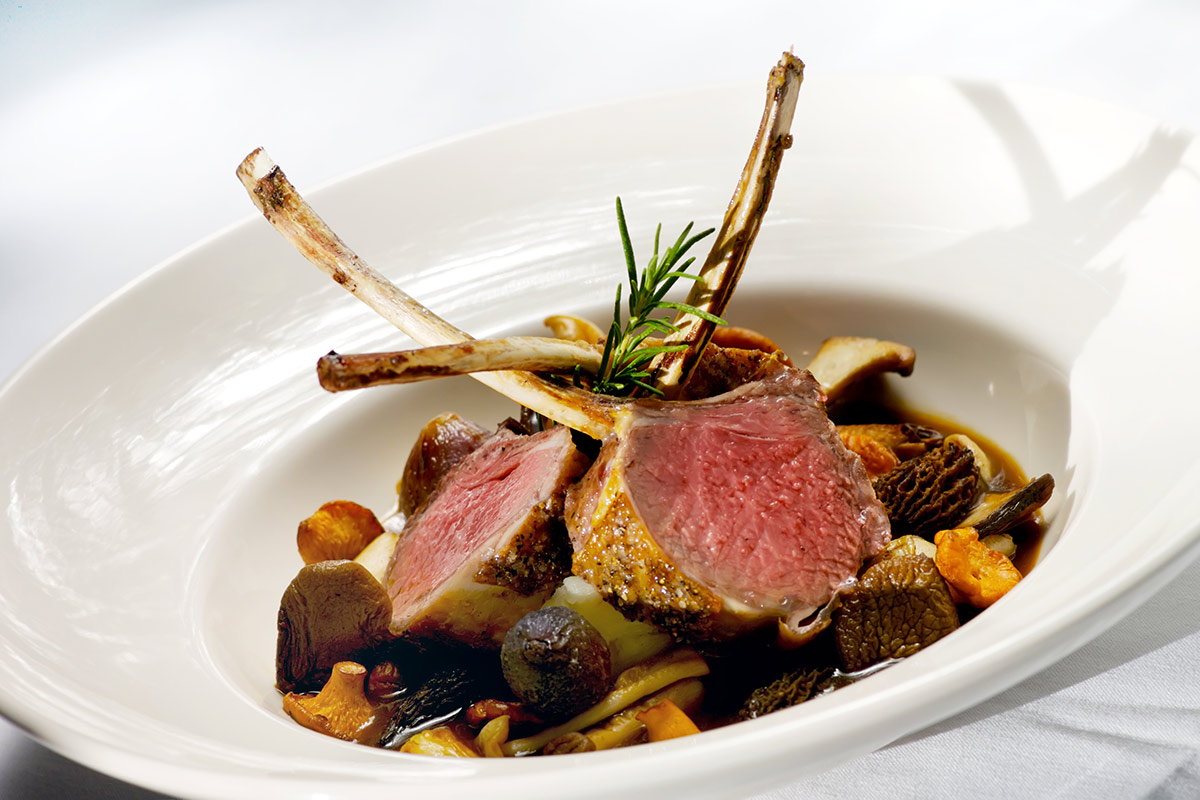 Crown Roast of Lamb This is an elegant yet easy dish that will wow your guests. A crown roast is simply two racks of lamb, 7 or 8 chops each, tied together at the ends to form a circle. You can do it yourself with butcher’s string or ask your butcher to assemble it for you. The meat is… view recipe
 Focaccia con Patate In Southern Italy, mashed potatoes are often worked into focaccia dough, but I like to use thin slices of potato as a topping. Fingerling potatoes yield perfectly sized discs, but you can also use creamer or new red potatoes. Getting the slices as thin as possible is more important than the diameter so that they’ll… view recipe
 Pallotte Cacio e Pepe Similar to arancini (rice balls) but even simpler to make, pallotte cacio e uova—cheese-and-egg balls—are a classic poor man’s dish from the Abruzzo region that was traditionally made from leftovers. The balls are usually deep-fried, but I prefer to sauté them for a lighter taste. Often served as a first course, they also make a… view recipe