
Kale Caesar Salad Recipe, Spotlight on Kale, Maximizing Kale’s Nutrients and The Warm-Up that Boosts Speed and Power
When it comes to dark leafy greens, kale occupies a heightened position thanks to its wide range of nutrients. And yet, shockingly, researchers have found that the body doesn’t absorb as many of them as hoped…unless you eat it with a healthy fat source, like extra virgin olive oil. I’m also sharing the trick to make this hearty green more tender, which also involves olive oil. It’s another reason why these two ingredients are a match made in heaven.
Kale Caesar Salad
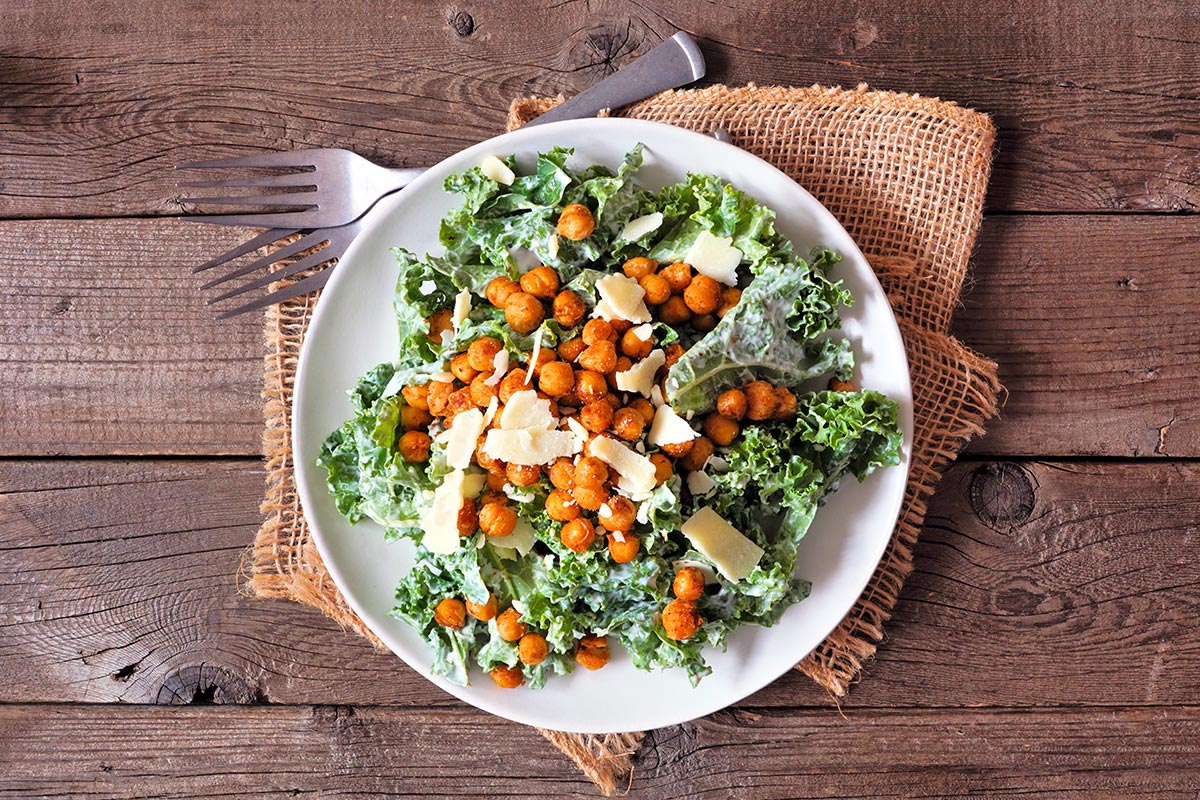 Kale Caesar Salad
This recipe makes Caesar salad more nutrient-rich in two yummy ways: using kale instead of Romaine lettuce and replacing croutons with roasted chickpeas, which can be seasoned any way you like. Both ingredients add texture as well as taste.
Ingredients
- 1 large or 2 small bunches kale (about 10 to 12 ounces), rinsed and patted dry
- 3/4 cup extra virgin olive oil, divided use
- One 15-ounce can chickpeas
- 1/2 teaspoon coarse sea salt
- 1 teaspoon dried herbs or spices
- 1 small can anchovies (2 ounces or less) or 2 tablespoons anchovy paste
- 4 cloves garlic
- 1 tablespoon Dijon mustard
- 1 teaspoon freshly ground black pepper
- 2 tablespoons freshly squeezed lemon juice, more to taste
Directions
Step 1
Separate the kale leaves and cut out and discard the main stems. Slice the leaves into ribbons and add to a large bowl. Drizzle on 3 tablespoons of olive oil and use your fingers to massage the oil into the kale for 2 to 3 minutes. Set aside while you roast the chickpeas and make the dressing.
Step 2
To roast the chickpeas, preheat your oven to 400°F. Rinse and drain them, then place on paper towels and dry as thoroughly as possible. Transfer to a rimmed sheet pan and toss with 1 tablespoon olive oil, the salt, and your choice of herbs and/or spices. Spread them out in an even layer and roast for a total of 30 minutes or until they’re brown and crunchy, turning them every 10 minutes.
Step 3
While the chickpeas are roasting, make the dressing. In a food processor, purée the anchovies and garlic, then add the mustard, black pepper, and lemon juice; process until smooth. With the machine running, add the remaining 1/2 cup olive oil and process until emulsified. Add the 1/4 cup cheese and pulse to blend.
Step 4
Toss the kale with just enough of the dressing to lightly coat and divide among 4 bowls. Top with a generous amount of chickpeas. Serve with more cheese and the rest of the dressing.
Note: Store any leftover chickpeas on a countertop in a container with a lid that’s slightly ajar; enjoy within 2 days—they make a great snack.
Yields 4 servings

Healthy Ingredient Spotlight
Kale Varieties
Do your own taste test to see which types appeal to you most:
Curly kale with its wavy edges is the most common variety. It has very tough stems, so you’ll want to strip away the leaves before using.
Tuscan kale, also known as dinosaur and lacinato kale, is more tender than curly kale, and its leaves are not as thick. You’ll still want to remove the stems.
Red kale, also known as scarlet kale and red Russian kale, is similar to curly kale in terms of shape but has that showy color.
Baby kale is far more tender and milder in taste than mature kale. It’s often served raw as part of a mixed green salad rather than cooked.

Quick Kitchen Nugget
The Rub on Kale
Even without the stems, kale can be tough. When it first gained popularity for all its nutrients, the hunt was on to make the leaves more palatable. Rubbing them with your fingers did help soften them somewhat, but the real trick is to massage them with extra virgin olive oil for a few minutes. The oil breaks down the natural waxy coating that protects the plant from the elements, notably rain, and in turn softens the greens. This massage has a double bonus, as you’ll see from the research below.

For Your Best Health
Maximizing Kale’s Nutrients
Kale made its way to the top of most “healthiest foods” lists because it’s rich in vitamins A, B6, C, K, and folate; minerals like manganese; fiber; and important phytonutrients like carotenoids. Now for the shocker: Kale’s prized nutrients are hard for the body to absorb unless it’s eaten with a fat like olive oil, according to researchers at the University of Missouri’s College of Agriculture, Food and Natural Resources (CAFNR).
“Kale is a nutrient-rich vegetable that contains carotenoids, including lutein, α-carotene, and β-carotene, which have beneficial effects on overall health,” said Ruojie (Vanessa) Zhang, assistant professor in the Division of Food, Nutrition and Exercise Sciences at CAFNR. These compounds, along with vitamins C and E and other bioactive plant chemicals in kale, have been associated with stronger immunity, improved vision, and a lower risk of diseases including diabetes, heart disease, and some cancers. “The problem is our bodies have a hard time absorbing these nutrients because they are fat-soluble rather than water-soluble,” she said.
To find what types of prep would make carotenoids easier for the body to access, the researchers evaluated kale prepared in different ways: raw; cooked; cooked with oil-based sauce, or cooked and then served with the sauce. They used a laboratory model that mimics human digestion to assess each option.

The experiments showed that raw kale on its own resulted in very low carotenoid absorption and cooking kale slightly reduced absorption even further. But pairing it with the sauce significantly increased the amount of absorbed carotenoids, whether the kale was raw or cooked. Cooking the kale with the sauce provided the same benefit as adding the sauce after cooking.
These results highlight practical, science-backed ways to help the body take in more beneficial nutrients from produce and how you can improve everyday meals simply by changing how foods are prepared or seasoned.
“Our team is committed to advancing food science with the goal of improving human health through the development of innovative foods and technologies,” she said. “We believe impactful science can drive meaningful change in global nutrition and well-being, and we’re excited to contribute to that mission.”

Fitness Flash
The Warm-Up that Boosts Speed and Power
Whether preparing for a marathon, squeezing in an after-work gym session, or stepping onto the field for a professional game, warming up plays a crucial role in your performance.
Research from Edith Cowan University (ECU) exploring whether warm-up routines could influence exercise performance found that elevated muscle temperature improves the speed and force of muscle contractions. This effect was especially noticeable during rapid high-power movements.
“The research found that for every 1°C increase in muscle temperature, performance improved by about 3.5%, with the greatest benefits seen in rate-dependent muscle properties like speed and power, but not in maximum strength,” said lead researcher Cody Wilson, PhD.
The study assessed how different types of warm-ups influence muscular performance. Passive warm-ups relied on external heat sources, such as a heating pad or a hot shower, to increase muscle temperature without movement. Active warm-ups involved gentle activity like 10 minutes on a stationary bike or completing a lighter version of the upcoming exercise.
“While both active and passive warm-ups result in better speed and power, a lot of research shows that the warm-up exercises should be similar to the exercise you will be doing. If you are lifting weights, starting out by doing the exercise with lighter weights, because the practice actually helps us activate our muscles more and use more efficient movement patterns—the nervous system can learn on the spot,” said fellow author and PhD candidate JP Nunes.
Dr. Wilson agreed that warm-ups that resemble the main workout can support better performance outcomes: “Any warm-up is important, whether that’s just walking to the gym or doing a 10-minute cycle before your workout. But there is some indication that warm-ups not related to the exercise being performed do not have as great an effect on performance as just ‘practicing’ the performance.”
When it comes to deciding the right moment to shift from warming up to working out, ECU Professor of Biomechanics Tony Blazevich notes that there is no universal guideline. “As you are warming up, you will feel the movements become easier, and you will get more accurate and coordinated. You might even start to sweat. We often say that once you get that light sweat, you have probably raised your temperature sufficiently to start your workout. The important thing is to start moving. Whether that is with a light walk or taking a few flights of stairs. Eventually you can work up to a full workout, when a proper warm-up will have its greatest effect.”
Get More Recipes In Your Inbox!