
Pecan Chocolate Chip Cookies Recipe, Spotlight on Pecans, Chilling Cookie Dough, Rethinking (Dietary) Cheating and Avoiding Falls
Chocolate chip cookies are an American classic with hundreds of variations. My recipe adds healthy ingredients so you can feel good about indulging. Speaking of indulging, new research shows that occasional splurges don’t have to derail a smart eating plan. It turns out that your mindset matters more than the calories on your plate. Read the details below.
Pecan Chocolate Chip Cookies
 Pecan Chocolate Chip Cookies
Who doesn’t love chocolate chip cookies? This recipe transforms the classic formula by replacing half the butter with extra virgin olive oil and adding nutritious whole wheat flour and pecans, which lend a nutty crunch. For best results, bake only one sheet of cookies at a time. This recipe makes a large batch. If you only need a smaller one, put one dough log in the freezer for the future.
Ingredients
- 1-1/2 cups cake flour
- 1-1/2 cups bread flour
- 3/4 cup white or golden whole wheat flour
- 1-1/2 teaspoons baking soda
- 1-1/2 teaspoons baking powder
- 1 teaspoon fine sea salt
- 6 ounces unsalted butter, softened
- 1-1/4 cups brown sugar
- 1 cup sugar
- 2 large eggs
- 1/2 cup extra virgin olive oil
- 2 teaspoons vanilla
- 1 pound dark or bittersweet chocolate chunks
- 10 ounces pecan halves
Directions
Step 1
In a large bowl, whisk together the flours, baking soda, baking powder, and salt and place next to your mixer or mixing bowl.
Step 2
Using a stand mixer fitted with the paddle attachment or a large bowl and a hand mixer on medium speed, blend the butter and sugars until smooth. Add the eggs, one at a time, then the olive oil and vanilla. On the lowest speed, add the flour mixture and beat until no traces of flour remain, about 20 seconds, then mix in the chocolate and pecans until evenly distributed, about another 20 seconds.
Step 3
Divide the dough between two long pieces of parchment paper and shape each into a thick log, about 3 inches in diameter. Roll up each log in its parchment and tuck under the ends. Wrap each log separately in foil, then refrigerate for 24 to 48 hours.
Step 4
When ready to bake, preheat your oven to 350°F. Slice one log into 10 disks and transfer to a rimmed sheet pan lined with parchment. Bake on a rack in the lower third of your oven until lightly brown, about 16 minutes, rotating the pan halfway through. Repeat with the second log. Let cool for at least 10 minutes before eating and let cool completely before storing in cookie tins.
Yields 20 oversized cookies

Healthy Ingredient Spotlight
Pecans
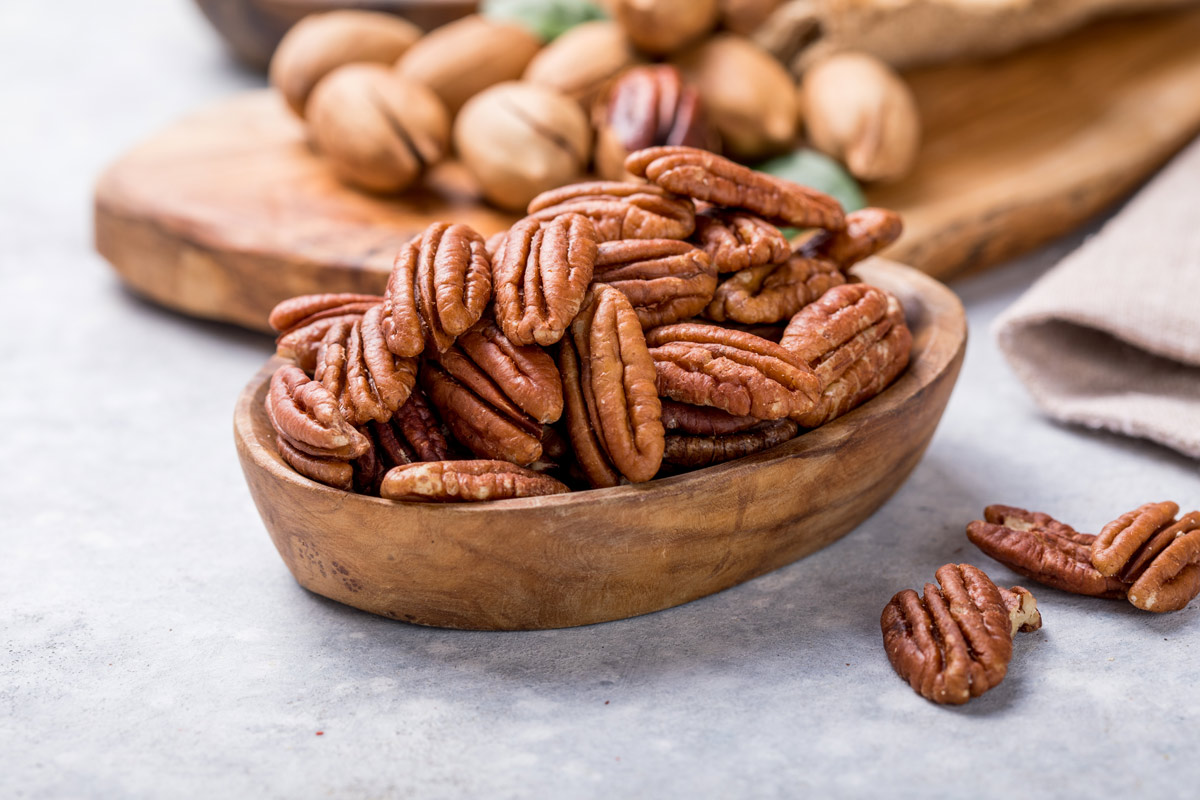
A high-quality source of protein with few carbs and zero cholesterol, unroasted and unsalted pecans have the American Heart Association’s Heart-Check mark to show that they meet nutritional guidelines for heart health. Pecans are rich in vitamins and minerals, including vitamin A, vitamin E, folic acid and other B vitamins, calcium, magnesium, phosphorus, potassium, and zinc, and one-and-a-half ounces of these sweet nuts deliver 15% of daily fiber needs. As part of a diet low in saturated fat and cholesterol, they may also reduce the risk of heart disease.

Quick Kitchen Nugget
Chilling Cookie Dough
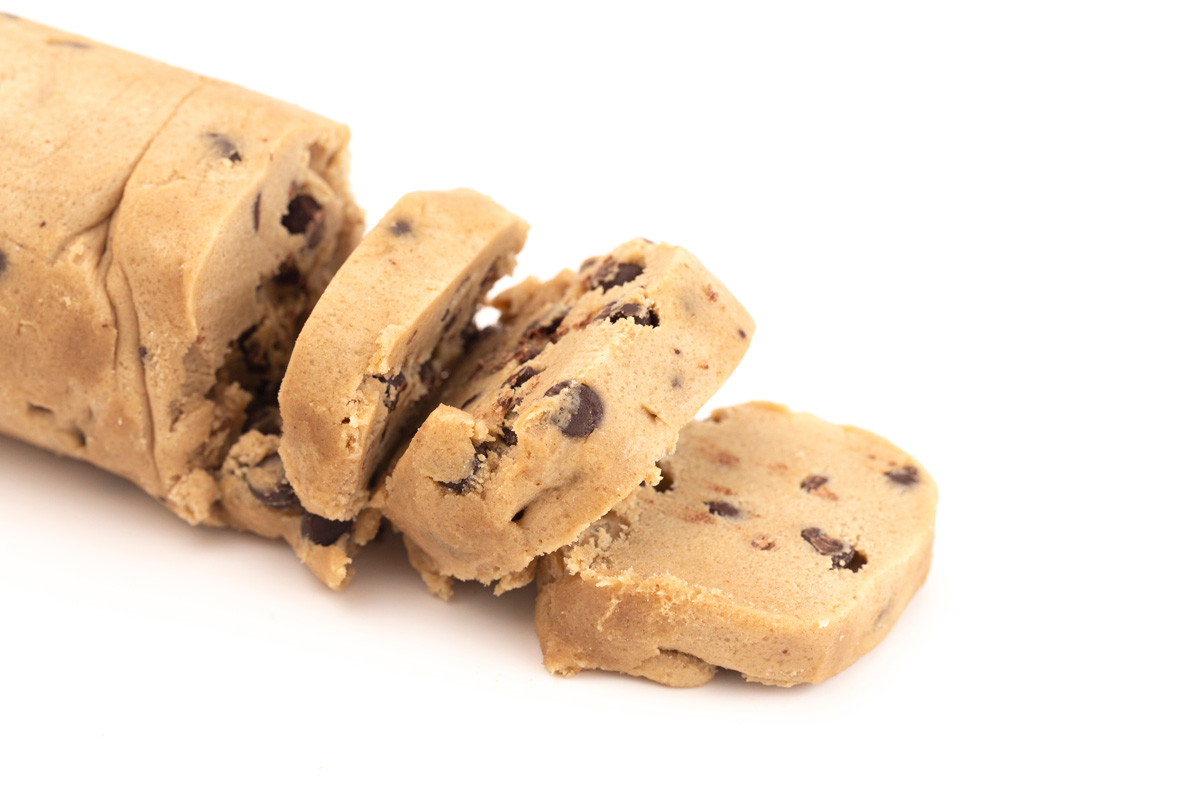
Many types of cookies require chilling for easier rolling and cutting, but there’s another key reason for this step: richer taste and texture. This happens as the structure of the flour and sugar change over time. If you’re in a rush, allow a minimum of 30 minutes in the refrigerator, but for the tastiest results, 24 hours or more is better. In fact, cookie dough can be kept in the fridge for as long as 3 days before baking. If you’ll be storing the dough any longer than that, place it in the freezer.

For Your Best Health
Rethinking (Dietary) Cheating
For many people trying to lose weight, a “cheat meal” feels like a well-earned break from strict dieting—a chance to relax, enjoy something decadent, and return to routine refreshed. Eric Trexler, PhD, a fellow in the Health, Wellness, and Physical Education Department at Duke University, recently coauthored a study examining the surprisingly complicated world of cheat meals. The analysis looked at both psychological and physiological effects of loosening dietary rules and found that planned indulgences can help some people stay on track. But science also warns that unplanned or binge-like episodes may fuel guilt, shame, and unhealthy eating patterns.
“People really overestimate the physical impact of a cheat meal and dramatically underestimate the psychological impact,” said Dr. Trexler, who conducts evolutionary anthropology research and collaborates with global health researchers at the Duke University School of Medicine. Though his doctoral research explored dietary nitrate and blood flow, he’s also examined what he calls “nonlinear dieting strategies,” an approach that intentionally includes higher-calorie days or meals during weight loss. He detailed what people misunderstand most about these meals and how mindset matters more than the calories on a plate.
Dr. Trexler said that people tend to panic about how many pounds they’ll gain from a single cheat meal. The truth? Physically, one big dinner does almost nothing in the long term. Mentally, though, framing it as cheating can fuel guilt, shame, and the feeling that you’ve blown your diet, which can derail progress. When an indulgence is spontaneous or emotionally driven, the guilt that follows can easily snowball into overeating—turning a single cheat meal into a cheat weekend and then a cheat week. On the other hand, when a higher-calorie meal is intentional and fits within a larger eating plan, people tend to stay more motivated. Ideally, you enjoy the meal and then return to normal eating.
“A dietary strategy that has a lot of planned dietary deviations in place tells you, ‘You can do this,’” Dr. Trexler said. “You can implement these lifestyle changes. You don’t need to be perfect 100% of the time. You need to be good enough most of the time, and you are.”
According to Dr. Trexler, cheat meals aren’t inherently good or bad. The key is how intentional they are, how you think about them, and what happens afterward. Instead of “cheating,” a term that suggests a moral failure, he urges people to think about planned flexibility as part of a sustainable eating pattern—one that lets you enjoy your grandmother’s caramel cake “without worrying how many eggs or cups of sugar are in it,” he said. “Eating isn’t just about nutrition. Eating is a social and cultural event. At a certain point, implemented long enough, changes become the norm. You realize you can enjoy sitting down for dessert and having one piece of cake instead of two.”
Dr. Trexler warned of two red flags to look out for: turning one indulgence into a multiday binge and overcorrecting with extreme restriction or punishing exercise. Both patterns mirror the binge-restrict cycle common in disordered eating.

Fitness Flash
Avoiding Falls
A new study published in JAMA Ophthalmology found it’s not just that poor vision increases fall risk or that hazards increase fall risk—it’s the interaction between the two that really matters. Older adults with severe vision loss are three to four times more likely to fall when they live in homes with hazards such as missing grab bars, tripping risks like loose rugs and wires, or uneven floors.
“The home is not just a background; it’s a key shaper of fall risk,” said lead author Shu Xu, PhD, a postdoctoral fellow at the University of Michigan’s Institute for Social Research. “Our study emphasizes the need to include the home environment as a key component of fall prevention, especially for older adults with vision loss. If we focus only on improving vision, we may overlook a group at very high risk: people who have both poor vision and hazards in their homes.”
The population-based cross-sectional study analyzed data from the National Health and Aging Trends Study, which gathered nationally representative data on US Medicare beneficiaries age 65 and older adults living at home.
Dr. Xu and colleagues documented that nearly half of older adults lacked grab bars in the bathroom. More than half of the sample lived with at least one hazard. Tripping hazards affected 9.5% of homes, broken flooring was present in 4.5% of them, and a total of roughly 7% of homes had two hazards.
“When an older adult with normal vision lives in a home with multiple hazards, fall risk is relatively low, but with high levels of vision impairment, fall risk increases threefold to fourfold,” Dr. Xu said. “Importantly, even among those with high levels of vision impairment, fall risk only increases significantly when home hazards are present.”
Incremental declines in vision directly raise fall risk for older adults with hazards in the home. Researchers measured specific visual functions and found that each one-line difference on the Snellen visual acuity chart—which tests how clearly a person can see by having them read letters of decreasing size from a set distance—was associated with a 31% increase in fall risk. Each one-line loss on the contrast sensitivity chart raised the risk by 14%.
These rising percentages suggest that poor vision may make it harder for older adults to detect and avoid existing dangers in their homes. The findings underscore that even small losses in vision may increase risk substantially when environmental hazards are present.
“Identifying and addressing home hazards is crucial,” said coauthor Joshua Ehrlich, MD, MPH, a professor of ophthalmology and a research associate professor at the Institute for Social Research. “Fall prevention should be framed as a partnership between health care and the physical home. In this case, vision care plus targeted home modifications.”
Falls are a major cause of morbidity and mortality. Just one fall can be devastating for an older person. Here are some simple concrete actions to take for yourself or older loved ones:
- Get regular eye exams and use the right glasses: Make sure prescriptions are up to date and use glasses as recommended.
- Check the bathroom first: Add grab bars near the toilet and in the shower or tub; use nonslip mats in the shower or tub.
- Clear walking paths: Remove or tape down loose rugs, move electrical cords out of walkways, and keep hallways and stairs free of clutter.
- Fix damaged flooring: Repair torn carpet, broken tiles, or uneven floorboards that could catch a foot, cane, or walker.
- Improve lighting: Use bright, even lighting, especially on stairs and in hallways; add night-lights near the bathroom and bedroom.