
Chicken Involtini Recipe, Spotlight on Chicken, A Better Approach to Losing Weight, and Why Workout Plans Go Awry
Want to elevate your next chicken dinner? Chicken involtini, or little bundles, is the delicious answer. Stuffed with spinach and cheese, it ticks all the boxes for flavor. This issue of the newsletter also serves up two studies—one on better ways to get help for losing weight and the other on how to rethink exercise for a better chance at sticking with a plan.
Chicken Involtini
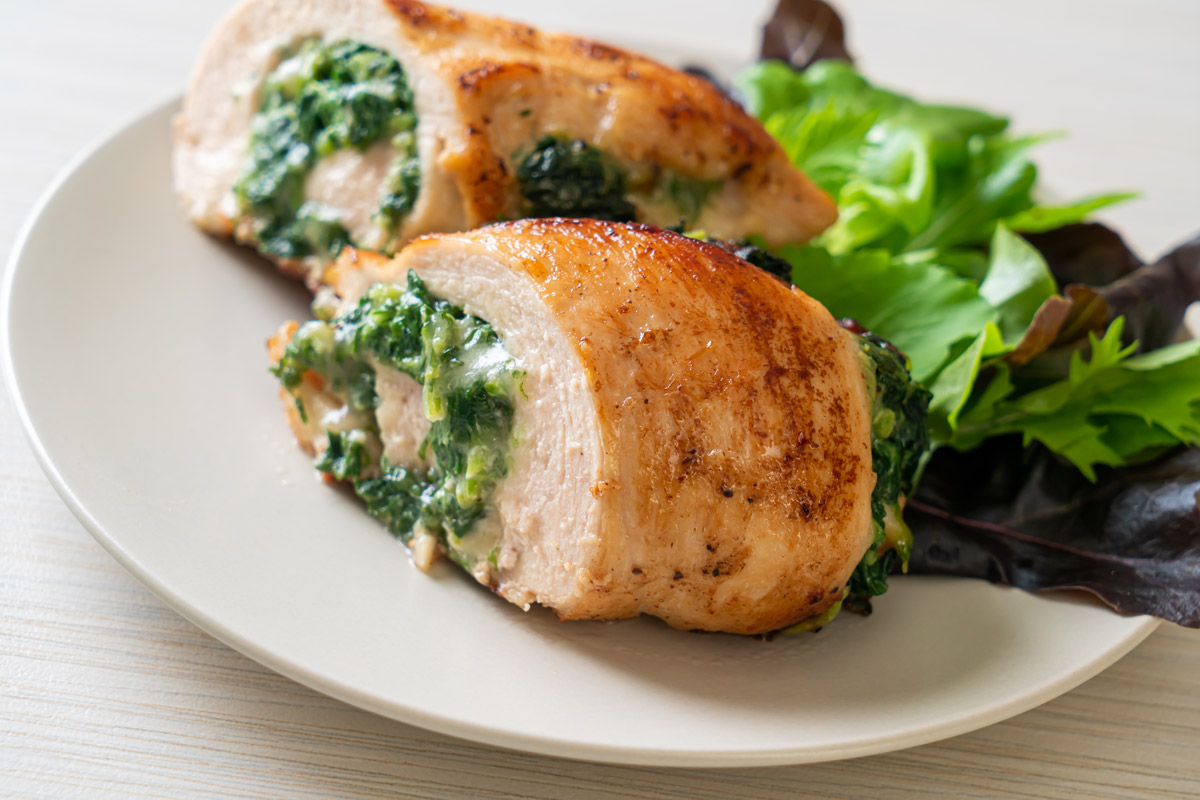 Chicken Involtini
These stuffed boneless chicken breasts are browned on the stovetop and then baked in the oven in an olive oil, lemon, and butter sauce. Enjoy on its own or over pasta.
Ingredients
- 7 tablespoons extra virgin olive oil, divided use
- 4 garlic cloves, finely chopped
- 12 ounces fresh baby spinach
- 1 teaspoon salt, divided use
- 1 teaspoon freshly ground black pepper, divided use
- 1/4 teaspoon crushed red pepper flakes
- 4 skinless boneless chicken breasts, about 2 pounds in total
- 8-ounce block Emmenthaler or provolone cheese, sliced into 8 sticks
- 1/3 cup whole wheat flour
- 1-1/2 cups homemade or store-bought low-sodium chicken stock
- Juice of half a lemon
- 2 tablespoons butter, cut into pieces
- 1/4 cup fresh flat-leaf parsley, finely chopped
Directions
Step 1
Heat a large oven-safe skillet over medium-high heat. When hot, add 3 tablespoons olive oil and the garlic. Cook the garlic until it becomes translucent, then add the spinach in bunches. As each bunch wilts, add the next. When completely wilted and tender, transfer to a colander and set the skillet aside. Let the spinach cool for 5 minutes, then squeeze with your hands to remove any excess liquid. Transfer to a large glass bowl and toss with 1/2 teaspoon salt, 1/2 teaspoon black pepper, and the red pepper flakes.
Step 2
Slice each breast horizontally to make eight cutlets. One at a time, place each cutlet between two sheets of parchment paper set on a cutting board, and use a kitchen mallet to pound it to about 1/4” thickness. Season each cutlet with the remaining salt and pepper.
Step 3
Top each cutlet with a layer of spinach, then place a stick of cheese in the center. Starting at the narrow end, roll up each cutlet and secure with a wooden skewer or toothpicks to keep the roll closed.
Step 4
Preheat your oven to 375°F. Put the flour in a pie plate and place it next to your stovetop. Wipe out the skillet and reheat it. When hot, add 4 tablespoons olive oil. Roll each bundle in the flour, shake off any excess, and add to the pan, seam side down. Brown on all sides, turning with heat-safe tongs. Deglaze the skillet with the stock, then add the lemon juice and butter. Place the skillet in the oven for 20 minutes or until an instant read thermometer placed in the chicken shows 160°F.
Step 5
Very carefully take the pan out of the oven. If you’d like a thicker sauce, plate the chicken and return the skillet to the stovetop. Bring to a boil and cook down for about 5 minutes. To serve, remove the skewers or toothpicks, drizzle on some sauce, and sprinkle on the parsley.
Yields 4 servings

Healthy Ingredient Spotlight
Chicken Breasts
Looking for a lean protein source? A 3-ounce serving of cooked skinless chicken breast delivers between 26 and 30 grams of protein for about 140 calories. You’ll also get B vitamins, particularly niacin and B6, and selenium, an essential trace mineral critical for supporting metabolism, among other functions.

Quick Kitchen Nugget
Pounding Chicken
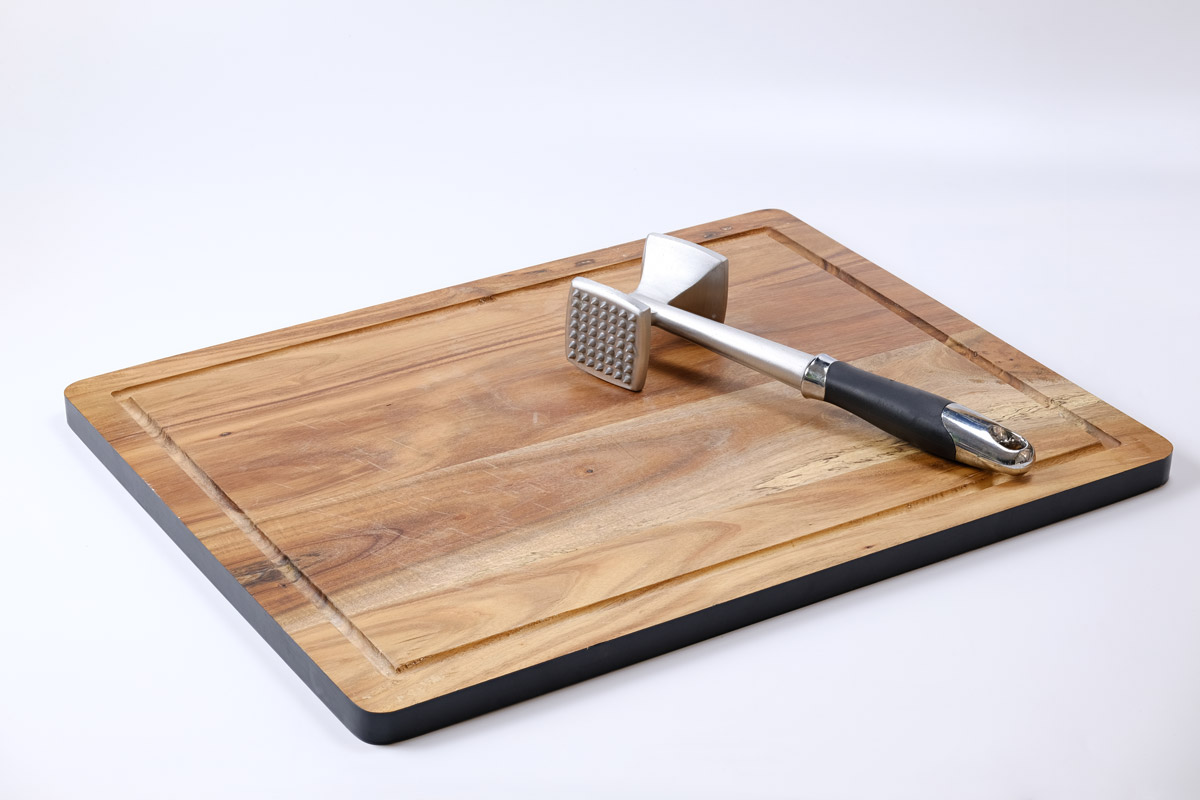
Pounded cutlets cook quickly and evenly because they have a uniform thickness. What’s more, pounding provides a bigger surface for stuffing which also makes rolling them up easier. It’s important to use a surface that can be easily and thoroughly cleaned, even though you’ll be pounding the chicken between sheets of parchment paper.
A meat mallet is a great tool; the flat side can be used on chicken and pork cutlets, and the side with the little spikes helps tenderize tougher cuts of beef. However, you can also make do with a heavy pan or even a rolling pin. Make sure to rotate the cutlet so you apply the force uniformly and not just to one or two spots. Start with moderate force and increase only if necessary to get an even thickness.

For Your Best Health
A Better Approach to Losing Weight
For a long time, endocrinologist Leigh Perreault, MD, felt uneasy about how weight management was handled in routine medical care. Too often, patients were sent home with vague advice to eat better and exercise more, even when that clearly was not enough.
“There was a moment I put my face in my hands and thought, ‘What am I doing?’ I would write a lot of prescriptions for patients’ diabetes, their blood pressure, their lipids, and all these other conditions,” said Dr. Perreault, a professor of endocrinology, metabolism, and diabetes at the University of Colorado Anschutz School of Medicine who practices in Westminster, Colorado, alongside primary care physicians. But she realized that many of those medications addressed symptoms rather than the root problem. “None of these people want to be on these medications, and I thought if I could just help them with their weight, many of these health concerns would probably go away,” she said. That realization set the stage for a new approach that could soon reshape how weight care would be addressed in primary care.
Dr.Perreault and her colleagues created PATHWEIGH, a structured process that helps people and their primary care teams focus directly on weight management. The program introduces dedicated clinic visits where providers can concentrate specifically on weight-related care instead of squeezing it into a standard appointment.
With funding from the National Institutes of Health, PATHWEIGH was rolled out across UCHealth’s 56 primary care clinics throughout Colorado to evaluate its impact. The pilot included 274,182 patients, making it one of the largest randomized trials ever conducted in this area. Results published in Nature Medicine showed that the program reduced population weight gain by 0.58 kg (about one and a quarter pounds) over 18 months and shifted the overall trend from steady gain to weight loss. Experts estimate that rising obesity rates are driven by an average population weight gain of about 0.50 kg or roughly a half pound every year. Stopping that increase and turning it into even modest weight loss could make a meaningful difference in slowing the obesity epidemic. “While it’s not a significant difference on an individual patient level, it’s a huge deal on a population and public health level,” Dr. Perreault said.
The program also made patients more likely to get help for weight issues. Participation increased the chances of receiving weight-related care by 23%. Most of that care involved lifestyle counseling, but prescriptions for anti-obesity medications doubled during the intervention. Unlike many one-size-fits-all weight-loss programs, PATHWEIGH allows treatment to be customized to each patient. It also reduces the discomfort that often surrounds conversations about weight in medical settings.
“With PATHWEIGH, we showed that we absolutely eliminated population weight gain across all of our primary care, which had never been done previously,” Dr. Perreault said. “If you think about weight loss medicine or surgery or a weight loss program, those are all vehicles to weight loss. We built a highway that we could put all the vehicles on, so there’s actually a process for people to receive weight-related care if they want it.
Dr. Perreault said the program’s success has opened the door to wider adoption. Plans are underway to expand PATHWEIGH beyond Colorado. The Obesity Association, which is developing its first standards of care for obesity, is highlighting the program as a recommended care process. Five health systems across seven states are also considering PATHWEIGH as its creators work toward licensing the model.

Fitness Flash
Why Workout Plans Go Awry
You know you should exercise, so you make a solid plan to do it, but then, in the decisive moment, you opt out. And then you choose to forgo your planned daily exercise again and again. Why? It could be related to what scientists call all-or-nothing thinking.
“Most people are tired and overwhelmed, so in the moment of decision, the immediate costs of exercising feel much bigger than the benefits, making it a low-value choice,” said University of Michigan behavioral scientist Michelle Segar, PhD. “This makes doing ‘nothing’ a prudent choice and desirable exit strategy. Decisions to not exercise are often made outside of awareness—so people are likely unaware that choosing to forgo their exercise plans could be related to having an all-or-nothing mindset.”
She suggests that all-or-nothing thinking is caused by a deeply embedded mindset that leads many people to abandon their exercise plans. “Exercise-related all-or-nothing thinking occurs when a specific exercise plan becomes unworkable,” Dr. Segar explained. “At this moment, when people cannot perfectly adhere to their plan—the ‘all’—they choose not to exercise at all rather than modify the plan.”
While all-or-nothing thinking has been studied in relation to eating and weight, this is the first in-depth research to investigate this phenomenon with exercise, Dr. Segar said. She and her colleagues Jen Taber, John Updegraff, and Alexis McGhee-Dinvaut, all of Kent State University, conducted four focus groups among 27 adults—ages 19 to 79—who tried to exercise but couldn’t stick with it. The study, published in BMC Public Health, uncovered four components that collectively make up an all-or-nothing mindset:
- Having rigid, idealized criteria for exercising. For most participants, their “all” constituted rigid standards that had to be met to exercise “right.” They typically say to themselves, “If I do something for under 15 minutes, I feel like I didn’t even exercise. Even if it were dead-out sprints, it just doesn’t factor into my head like I did anything.”
- Seeking excuses for not exercising. This component reflects participants actively trying to avoid their intended exercise. They said that exercising the right way took a lot of effort, saying, “It’s hard,” “It hurts,” and “It doesn’t feel good to do.”
- Believing exercise was expendable compared to their daily priorities. Participants said things like “When your routine ends up getting crowded with the things that have to be done or should be done, [exercising] is an easy thing to push to the side.”
- Being baffled about why they could not stick with exercise. Participants were unable to reconcile their current inactivity even though they could recall having had previous positive experiences exercising, saying things such as “I don’t understand why I don’t exercise. … I’m an educated woman… why can’t I even make a dent in it?”
“The all-or-nothing mindset creates high costs for exercising,” said Dr. Segar. Here’s her advice to overcome it:
- Don’t be a prisoner to your exercise past. Know that negative exercise experiences in your past can demotivate you now. Acknowledge that fact and then move forward in more positive and realistic ways.
- Don’t blame yourself for not sticking with exercise. Our culture has taught us an exercise formula that sets up most people to fail.
- Choose “good enough” over “perfect.” Nothing has to be perfect, including exercise.