
Pistachio Layer Cake Recipe, Spotlight on Buttermilk, How to Sift Dry Ingredients, Volunteering to Keep your Brain Younger, plus Tea, Coffee, and Women’s Bone Health
This romantic pistachio and white chocolate layer cake is delicious any time of the year, but it’s especially fitting for Valentine’s Day. This is also an excellent time to think about helping others, and a new study of volunteering made a link between selfless acts of service and helping brain health. I’m also sharing research on the effects of tea and coffee on women’s bone health—the results will surprise you.
Pistachio Layer Cake
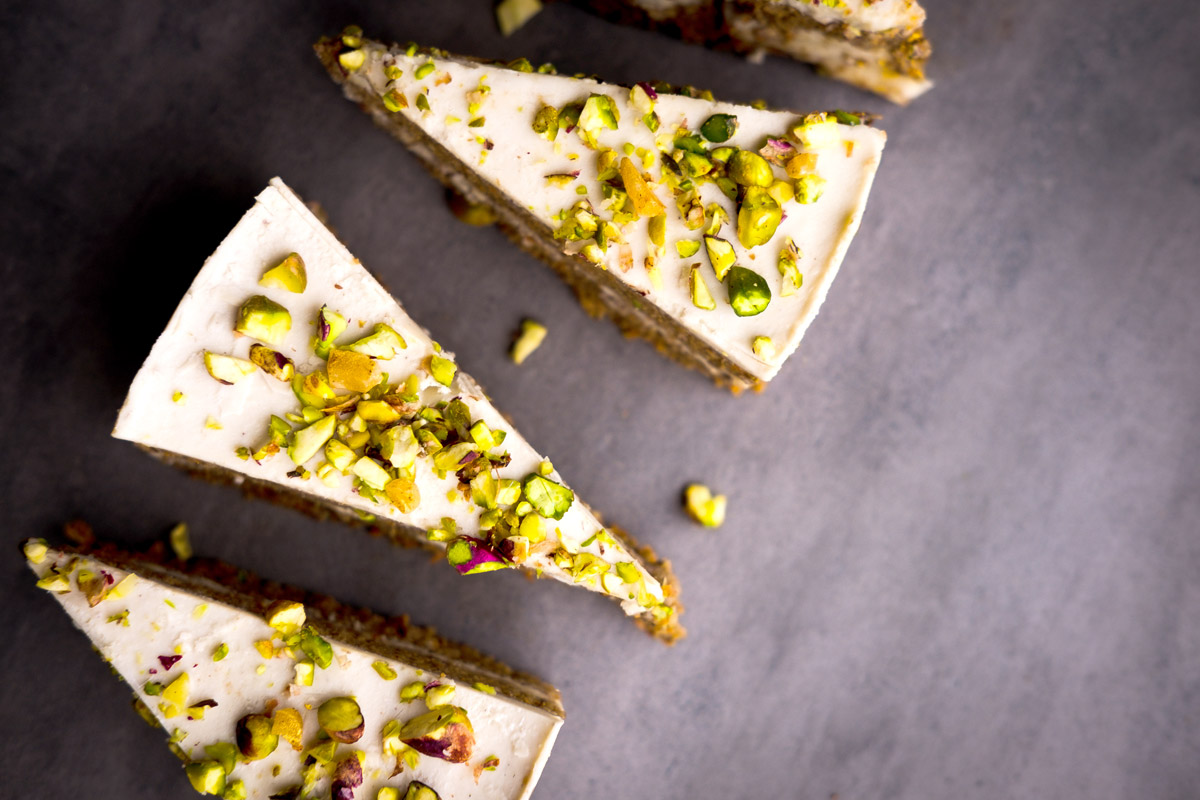 Pistachio Layer Cake
Pistachio-based cake layers are filled and iced with a whipped white chocolate ganache. The thin layer of raspberry preserves is a great counterpoint to the sweetness of the chocolate. Use a coffee bean or nut grinder to turn raw (unroasted and unsalted) pistachios into a ground powder. Note: If you don’t have buttermilk on hand, see the Healthy Ingredient Spotlight in our weekly newsletter for alternatives.Ingredients
For the frosting:
- 12 ounces white chocolate
- 1-1/2 cups heavy cream
For the cake layers:
- 3 cups all-purpose flour
- 2 teaspoons baking powder
- 1 teaspoon baking soda
- 1/2 teaspoon salt
- 4 ounces unsalted butter, well softened
- 1/2 cup olive oil
- 1-1/2 cups granulated sugar
- 4 large eggs
- 1 cup buttermilk
- 1 cup finely ground pistachios from about 4 ounces of raw nuts
- 2 teaspoons vanilla extract
To assemble:
- 1/2 cup raspberry preserves
- 2 ounces pistachios, coarsely chopped
Directions
Step 1
Start by making the frosting. Place the chocolate in a glass bowl. Heat the cream just to a simmer and pour over the chocolate. Let sit for 3 minutes, then whisk until smooth (if the heat of the cream wasn’t enough to melt all the chocolate, you can microwave the bowl for 30 seconds, then stir). Chill in the fridge for 4 hours to firm up.
Step 2
Meanwhile, make the cake layers. Preheat your oven to 350°F. Line two 9-inch cake pans with parchment paper; set aside.
Step 3
In a large bowl, sift together the flour, baking powder, baking soda, and salt; set aside.
Step 4
In the bowl of a stand mixer fitted with the paddle attachment or in a large bowl using a hand mixer, cream the butter, olive oil, and sugar until smooth, about 3 minutes. Add the eggs one at a time, then the buttermilk, ground pistachios, and vanilla. Whisk in the dry ingredients, then use a spatula to be sure all the flour is well incorporated.
Step 5
Divide the batter between the two pans and bake for 30 minutes or until the tip of a sharp knife inserted in the center of each cake comes out clean (rotate the pans halfway through for even baking). Let cool to room temperature.
Step 6
Ater the frosting has chilled, whip it on high speed until it thickens to frosting consistency, about 1 minute. Spread about 1/3 over one of the cake layers. Spread the raspberry preserves on the underside of the other layer, then stack it on top of the bottom layer. Frost the top and sides of the cake with the remaining frosting. Sprinkle the top with the chopped pistachios.
Yields 12 servings

Healthy Ingredient Spotlight
Buttermilk
True buttermilk is the fermented liquid that separates from the fat mass when churning butter. The buttermilk sold in supermarkets is milk that has fermented thanks to the addition of live cultures. Though rich and creamy, buttermilk is low in fat with a high acidity level. It makes baked goods very fluffy—that’s why buttermilk biscuits and buttermilk pancakes are so popular. In a pinch, you can create a cup of buttermilk by adding 1 tablespoon of lemon juice or distilled vinegar to 1 cup of milk and letting it sit for a few minutes until it curdles.

Quick Kitchen Nugget
Sifting Dry Ingredients
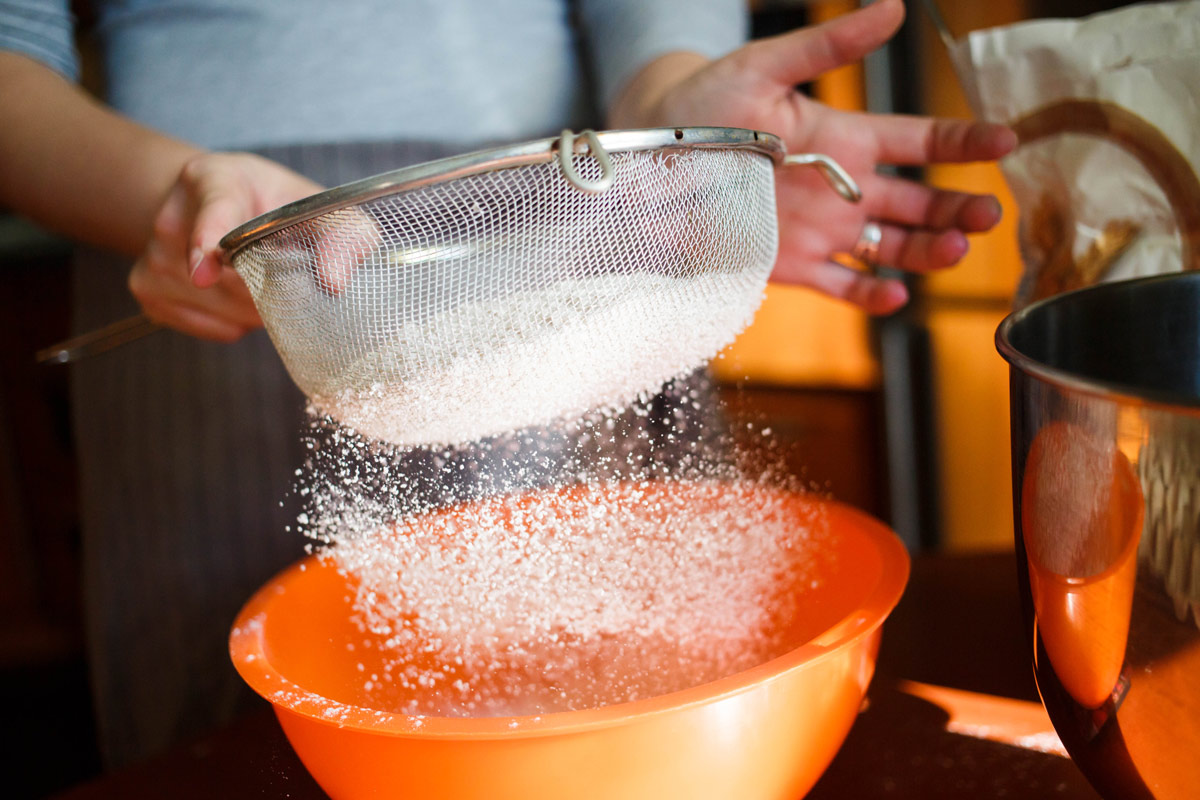
Whether with a dedicated sifter or a fine mesh strainer with a spoon acting as a pusher, sifting dry ingredients is a great way to better mix them as well as get rid of any possible lumps, especially with cocoa powder and confectioners’ sugar. Some pre-ground nut flours, like almond meal, can also develop clumps, but you may need a tool with a wider mesh to sift them. Keep in mind that when sifting numerous ingredients together, you’ll still need to whisk them to fully distribute them.

For Your Best Health
Volunteering to Keep your Brain Younger
Strong social ties are often linked to better health, and new research adds a brain benefit to that list. Researchers from The University of Texas at Austin and the University of Massachusetts Boston report that regularly helping people outside your household can noticeably slow cognitive decline in middle-aged and older adults, even if it’s just a few hours a week.
The researchers followed more than 30,000 adults in the US for two decades and found the decline was reduced by about 15% to 20% among those who either volunteered formally or helped in informal ways, such as supporting neighbors, family, or friends. Both formal volunteering and informal acts were linked to noticeably slower cognitive decline over time. The benefits added up year after year and didn’t require a huge time commitment. Even modest everyday helping packed a powerful mental payoff.

“Everyday acts of support—whether organized or personal—can have lasting cognitive impact,” said Sae Hwang Han, PhD, Assistant Professor of Human Development and Family Sciences at UT who led the study. “What stood out to me was that the cognitive benefits of helping others weren’t just short-term boosts but cumulative over time with sustained engagement, and these benefits were evident for both formal volunteering and informal helping. And in addition to that, moderate engagement of just two to four hours was consistently linked to robust benefits.”
These results strengthen the case for thinking about volunteering, helping, and neighborhood connection as public health issues. This may be especially important later in life, when conditions tied to cognitive decline and impairment, including Alzheimer’s, are more likely to develop.
Related work led by Dr. Han found that volunteering helped counter the harmful effects of chronic stress on systemic inflammation, a known biological pathway linked to cognitive decline and dementia. The benefit was strongest among people with higher levels of inflammation. Taken together, these findings suggest helping others may support brain health in more than one way. It may reduce the physical strain linked to stress, and it may strengthen social bonds that provide psychological, emotional, and cognitive support. As societies age and concerns about loneliness and isolation grow, the results also support continued efforts to keep people involved in ways that let them contribute, even after cognitive decline has begun.
“Many older adults in suboptimal health often continue to make valuable contributions to those around them,” Dr. Han said, “and they also may be the ones to especially benefit from being provided with opportunities to help.”

Fitness Flash
Tea, Coffee, and Women’s Bone Health
An investigation from Flinders University in South Australia sheds new light on how two widely consumed drinks, coffee and tea, could play a role in bone health for women later in life. The study, published in the journal Nutrients, monitored nearly 10,000 women aged 65 and older for 10 years to examine whether regularly drinking coffee or tea was connected to changes in bone mineral density (BMD).
BMD is a central marker used to assess osteoporosis risk. Osteoporosis affects one in three women over 50 and leads to millions of fractures every year, making bone health an important global issue. Because coffee and tea are part of daily routines for billions of people, researchers noted that understanding their long-term effects on bones is essential. Previous findings have often been inconsistent, and few studies have followed such a large group across an entire decade.
The researchers used information from the Study of Osteoporotic Fractures, drawing on repeated measures of beverage intake and BMD at the hip and femoral neck. These areas are closely tied to fracture risk. Throughout the 10-year period, participants regularly reported how much coffee and tea they consumed. At the same time, bone density was assessed using advanced imaging tools.
Results showed that women who drank tea had slightly higher total hip BMD than those who did not. Although the improvement was small, it was statistically significant and may matter when considering the health of a large population.
“Even small improvements in bone density can translate into fewer fractures across large groups,” said Adjunct Associate Professor Enwu Liu, PhD, from the College of Medicine and Public Health.
Findings for coffee were more varied. Moderate intake, roughly two to three cups a day, was not associated with harm. However, consuming more than five cups per day was linked to lower BMD, indicating that very high levels of coffee could negatively affect bone strength. Women with higher lifetime alcohol intake appeared particularly vulnerable to coffee’s negative effects, whereas tea showed stronger benefits in women with obesity.
Ryan Liu, co-author of the study, explains that tea is rich in catechins, compounds that may encourage bone formation and help slow bone loss. “Coffee’s caffeine content, by contrast, has been shown in laboratory studies to interfere with calcium absorption and bone metabolism, though these effects are small and can be offset by adding milk,” he said.
Dr. Enwu Liu noted that the research suggests drinking tea daily may be an easy way to support bone health as people grow older. “While moderate coffee drinking appears safe, very high consumption may not be ideal, especially for women who drink alcohol,” he said.
The researchers emphasized that while the results are statistically meaningful, the differences are not dramatic enough to require sweeping lifestyle changes. “Our results don’t mean you need to give up coffee or start drinking tea by the gallon,” said Dr. Liu. “But they do suggest that moderate tea consumption could be one simple way to support bone health and that very high coffee intake might not be ideal, especially for women who drink alcohol. While calcium and vitamin D remain cornerstones of bone health, what’s in your cup could play a role too. For older women, enjoying a daily cup of tea may be more than a comforting ritual; it could be a small step toward stronger bones.”
Get More Recipes In Your Inbox!